Note: In this post I relate the story of retracing my steps to prove to my distant Uruguayan cousin the existence of his great-aunt and -uncle’s daughter whom he knew nothing about. His great-uncle was a noted art historian Curt Glaser in Berlin who like many Jews in the Nazi era suffered the loss of his profession and more.
The last several months have been among the most prolific periods learning new things about my extended family, primarily from people searching for their ancestors and stumbling upon my Blog. By having more than 400 categories by which my post could potentially turn up in an Internet search, an approach incidentally not recommended by web designers, many people have come upon my writings. In coming weeks, I will relate some of the mysteries I have been able to unlock because of recent reader emails, including an extraordinary communication I received from one individual which resulted in obtaining hundreds of photographs and documents about one of my renowned Bruck relatives who was born and raised in Breslau, Germany [today: Wrocław, Poland]. But this is a story for another day.
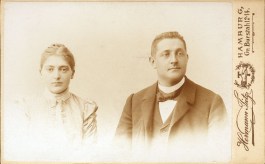
The current post stems from a note I received from a delightful Uruguayan man, Eduardo Castro (Figure 1) and an ensuing discovery I made about his family. This gentleman is a fourth cousin once removed as it happens, and he learned about my blog from his aunt and another mutual cousin, Danny Alejandro Sandler. (Figure 2) Eduardo’s aunt, Bettina Basanow née Meyer, was born in Vacaria, Rio Grande do Sul, Brazil but has lived in Denver, Colorado for more than 50 years. In Post 90, I related the story of trying to locate Bettina and her siblings in Porto Alegre, Brazil, where her parents had emigrated to escape the Holocaust. Thinking Bettina and her family still lived in Brazil, I spent many fruitless months trying to track them down there. My much more social media savvy cousin Danny Sandler eventually located Bettina in Denver and put us in touch.
I have periodically told readers about the difficulty of finding evidence of one’s Jewish ancestors who emigrated to South America to escape certain death in Europe during WWII. While I have been assured that certain South America countries are notorious record keepers, not unlike the Germans, most of these records have not yet been automated making online searches for documentary evidence from there difficult. For this reason, it is always immensely gratifying when descendants of people who emigrated to South America find me through my Blog, as in Eduardo’s case. I often learn the fate of some of their ancestors as well as the indirect route some may have taken to get to South America. In a subsequent post, I will relate the story of one such venture. But, again, this is a story for another day.
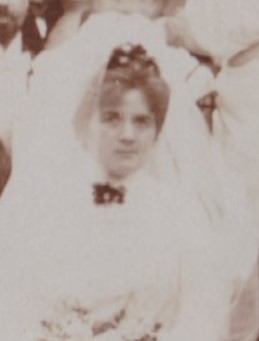
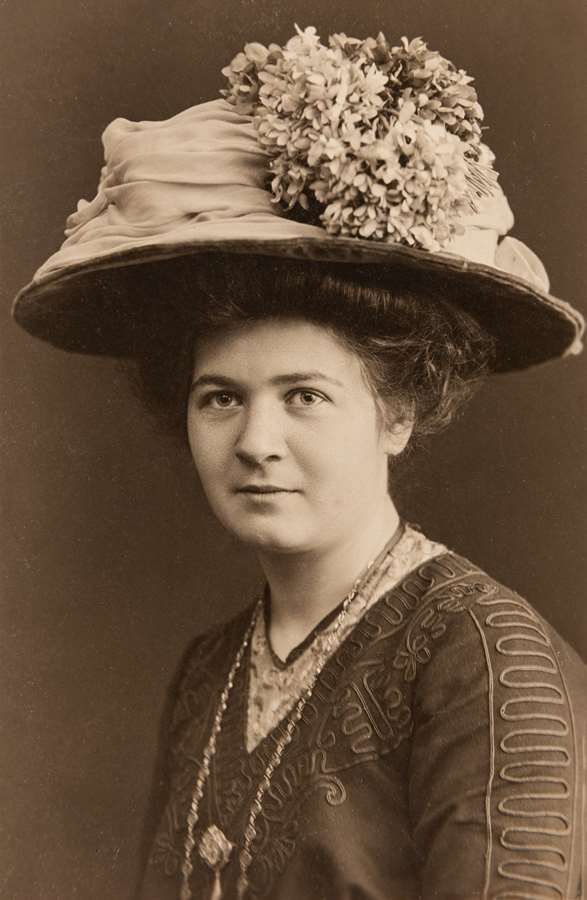
Shortly after Eduardo and I began our exchanges, I invited him as a “guest” on my family tree. After catching several errors and sending me images of his immediate family, he became curious about a daughter his great-aunt Maria Johanna Dorothea Clara Glaser née Milch (Figure 3) had with her renowned husband Curt Glaser (Figure 4) named Eva Glaser that I include in my tree. Eduardo had never heard about this daughter so asked me for the source of my information.
Periodically I find myself in the awkward position of being asked to substantiate the existence of a previously unknown ancestor to a member of the family more closely akin to them than I am. I understand this situation. Had someone ever told me that my father had an older brother born in 1900, as he in fact did, that I knew nothing about, I would have scoffed. Obviously, why would my father never have told me this? In the case of this uncle, I only learned of his existence when I visited the “Archiwum Państwowe w Katowicach Oddział w Raciborzu” (“State Archives in Katowice Branch in Raciborz”) and found verification of his birth in 1900 and of his death less than a year later.
In any case, Eduardo Castro would certainly have better knowledge of Eva Glaser as they would have been first cousins once removed. Because I had failed to make a note of where I had found the place and date of her birth I was forced to try and retrace my steps, making new discoveries along the way.
Fortunately, I quickly rediscovered Maria and Curt Glaser’s respective “Declaration of Intention” dated the 16th of October 1941 in New York (Figures 5-6) stating their aim to become citizens of the United States and reside permanently herein. Asked on this form to indicate the number of living children, and their name, sex, date and place of birth, place of residence, both had written “Eva(f) July 22, 1935 born at (sic) Switzerland resides at (sic) Switzerland.” This was confirmation that Eva had indeed existed even though nowhere on this form did it state that Eva was born in Ascona, Switzerland, as I had written on my family tree.
Thinking I had perhaps come across Eva’s place of place in an article about her famous father, I did a Google query on him, and found a fleeting reference to her.
First, let me briefly tell readers about Eva’s father Curt Glaser (1879-1943) as his was an interesting story reflective of the fate of many Jews living in Germany during the 1930’s. Curt was born on May 29, 1879 in Leipzig, Germany, the son of a Jewish family. Almost immediately after receiving his M.D. in 1902, he began a second degree in art history, a topic that had always interested him. At the same time, he also became active as an art critic and began to write reviews on the Berlin art scene, an activity that lasted over 30 years. On the 12th of August 1903, he married Elsa Kolker (1878-1932) (Figures 7a-b), daughter of the Ambassador Hugo Kolker, converted to Protestantism, and received considerable income from the family properties.
Curt received his Ph.D. in 1907 writing his dissertation on Hans Holbein the Elder. By 1909, Curt’s museum career had begun when he was appointed curator of the prints and drawings division (Kupferstichkabinett) at the Berlin Museum (Staatliche Museen Berlin) where he significantly expanded its collection of modern and contemporary art. In parallel to his professional acquisitions on behalf of the Kupferstichkabinett, starting around 1910, with the support of his father-in-law, Hugo Kolker, Elsa and Curt began to build a significant art collection that included, among others, the works of Vincent van Gogh, Henri Matisse (Figures 8a-c), and Pablo Picasso, as well as valuable prints by artists like Honoré Daumier and Adolph von Menzel.
The Glasers placed a significant emphasis on acquiring the works of Edvard Munch, a lifelong friend whom Glaser had supported. (Figures 9a-b) A special friendship existed between the Glasers and Munch, who painted portraits of Elsa alone as well as of the couple. (Figure 10) The Glasers had the most extensive collection of his works in Berlin.
Curt Glaser clearly supported other artists as evidenced by at least two paintings he commissioned from the German artist Max Beckmann (1884-1950). (Figures 11-12) In addition, Henri Matisse painted Elsa Glaser on several occasions.
In October 1924, Glaser became the Director of the Staatliche Kunstbibliothek (State Art Library) in Berlin, whereupon he recast the library as an art historical research library. By July of the following year, the Glasers had moved into a civil service apartment where their art collection was also displayed and where they held important art salons throughout the late 1920’s. (Figures 13-17)
Elsa Glaser passed away at the age of 54 in 1932, a loss that deeply affected Curt and that he expressed in personal letters to Edvard Munch. After the National Socialists rose to power, in the spring of 1933, Glaser was placed on leave from the Kunstbibliothek because of his Jewish ancestry, his prominence, and no doubt because of his approach to collecting art deemed degenerate by the Nazis. At the same time, Glaser was compelled to relinquish his apartment. Around this time, he found happiness anew with Eduardo Castro’s great-aunt Maria Milch, whom he married on the 30th of May 1933. (Figures 18a-b) Even before he was forced to retire in September 1933, he had auctioned off large parts of his collection, home furnishings, and art library, much of it at depressed prices.
Curt and Maria went into exile in June 1933, going first to Paris, then to Ascona, Switzerland, making the birth of their daughter Eva there plausible. In a reference I happened upon entitled “Curt Glaser Report: III. Summary of the Historical Facts,” the unnamed author writes: “Between 1936 and 1938/1939, the Glasers stayed repeatedly in Florence with their daughter, who was born in 1936,” known, however, to have been born in July 1935. At the time, Curt was likely researching the history of the Renaissance in Florence, a topic he later published a manuscript about.
It is an interesting coincidence that my own uncle and aunt Dr. Franz Müller and Suzanne Müller née Bruck’s stay on the outskirts of Florence almost exactly coincided with that of the Glasers. I like to imagine they may have met. Regardless, as the unnamed author previously quoted wrote: “In 1941, the Glasers emigrated to New York without their daughter and moved in 1943 to Lake Placid. . . He died on November 23, 1943.” (Figures 19-21)
The reason the Glasers left their daughter behind nagged at me. Trying to determine why this might have been, I turned to Geni.com. Here I found mention of her, indicating she had died in 1943, thus, at 7 or 8 years of age. I contacted the Profile Manager of the tree and asked where he uncovered this information. He sent a very gracious reply with a link to an article dated the 20th of March 2020 from “Basellandschaftliche Zeitung” (English: Basellandschaftliche Newspaper), or “bz,” a Swiss Standard German language daily newspaper. The article entitled “Curt Glaser case: The squaring of the cultural circle: an agreement has been reached in the Glaser case” (Mensch) discussed the restitution agreement that had been reached between Curt Glaser’s heirs and the Art Commission of the Basel Art Museum, which was one of the primary beneficiaries of the depressed prices Curt received for his art collection auctioned off in 1933.
Buried within this article was the following paragraph: “Glaser had no direct descendants. His first marriage to Elsa [née Kolker (1878-1932)], with which he had built up his collection, remained childless. His only daughter Eva, who had been born with a trisomy-21 impairment, also died as an eight-year-old child in Arlesheim, when Curt Glaser and his second wife Maria were already in exile in the USA.” Trisomy-21 is the most common form of Down syndrome, caused by an extra copy of chromosome number 21.
In conclusion, the chance to track down why Curt and Maria Glaser may have left their daughter behind when they moved to America in 1941 was only possible because of the prominence of Curt Glaser and the multiple articles written about him. Eva’s impairment is the likely explanation for why her parents chose to leave her in Switzerland, perhaps thinking she would receive better care there. Leaving Eva behind must have been a bitter pill to swallow for Curt and Maria. Interestingly, both Curt and his daughter died the same year, 1943. (Figure 22)
CORRECTIONS & AMENDMENTS MADE ON 8TH MAY 2023 BASED ON COMMENTS PROVIDED BY A READER, FRANK WEBSTER-SMITH
Note: This post is a follow-up to Post 95 in which I discussed the sad fate of my great-grandfather’s niece, Charlotte Bruck, my first cousin twice removed. In this post, I talk about her first husband, Walter Edward Stavenhagen, to whom she was married for only four years (1906-1910) and with whom she had her only two children. Thanks to my German genealogist friend, Peter Hanke, I was finally able to determine when and where Walter died; Peter put me in touch with a Swiss gentleman, Achim Bucher-Stavenhagen, whose deceased wife was the granddaughter of Walter’s youngest brother, Herbert Frederick Stavenhagen. While only related to my family by marriage, the scope and breadth of the Stavenhagen family primary source documents I obtained from Mr. Bucher make the telling of this story compelling.
When writing Blog posts, I often begin by reviewing primary source documents relevant to the people or topic I am writing about. These are mostly written in German, and in the interest of accuracy and completeness, I sometimes ask my German friends or relatives to transcribe and/or translate original certificates, hoping for additional clues. I followed this process in writing the current post, and inadvertently wound up solving the mystery of what happened to Walter Edward Stavenhagen, first husband of Charlotte Bruck (Figure 1), my first cousin twice removed. While doing this, I obtained a trove of primary source documents, many of which are only tangentially relevant to the story I am about to relate.
Before my recent discoveries, the date and place of birth of Charlotte Bruck’s first husband, Walter Edward Stavenhagen, were already known to me from the Mecklenburg-Schwerin or Mecklenburg-Vorpommern (i.e., Mecklenburg-Western Pomerania), Germany 1900 census I found on ancestry.com (Figure 2a); the Stavenhagens originally hailed from Mecklenburg-Strelitz, a territory in Northern Germany. The 1900 census states Walter was born on the 1st of September 1876 in Calais, France.
As discussed in Post 95, on ancestry, I also found Walter Stavenhagen and Charlotte Bruck’s marriage certificate, showing Walter lived in Eichwerder [today: Dąbrowa, Poland] near Soldin, Germany [today: Myślibórz, Poland] (Figure 3) and stating they were married in Berlin on the 3rd of May 1906. Following their marriage, the couple lived on Walter’s estate in Eichwerder, where their two sons, Frederick Wilhelm and Hans Joachim (Figure 4), were born. A notation on their marriage certificate indicates Walter and Charlotte were divorced on the 19th of May 1910 (Figure 5); according to family accounts, the cause of Walter and Charlotte’s divorce stems from Charlotte’s postpartum depression or bi-polar disorder after the birth of her second son and Walter’s suspected spousal abuse. Charlotte obtained custody of her two boys, who never again saw their father, and eventually decamped to America where she sadly spent much of the remainder of her life in mental institutions because of schizophrenia.
Jay Dunn née Lorenzen, Walter and Charlotte Stavenhagen’s granddaughter, sent me primary source documents suggesting Walter stayed in Eichwerder following his divorce. Jay obtained these documents from a German archivist showing that, respectively, in 1911 (Figure 6a), 1919 (Figure 6b), and 1923 (Figure 6c), Walter was the best man for three weddings that took place on his estate in Eichwerder.
On ancestry I was able to locate a list of passengers including Walter’s name showing he travelled from Hamburg, Germany to Grimsby, England on the 22nd of May 1924 (Figure 7), presumably to visit family or conduct family business; this document states his German occupation as “gutsbesitzer,” estate owner, logically. Prior to my recent discoveries, the last physical evidence I could find of Walter’s whereabouts was another passenger list showing he again left from Hamburg, this time headed to Leith, England, on the 20th of August 1929 (Figure 8); then he is listed as farmer, for all intents and purposes the same occupation. Both the 1924 and 1929 Hamburg passenger lists confirm Walter’s date of birth as the 1st of September 1876
Having found nothing further on Walter Stavenhagen in ancestry in my general search, I next turned to a collection accessible there, namely, “Germany and Surrounding Areas, Address Books, 1815-1974” (“Adressbücher aus Deutschland und Umgebung, 1815-1974).” Two old address books exist for Soldin, one for 1925, another for 1931. Neither includes a listing for Walter Stavenhagen even though both directories would logically have covered the period when he could still have been living near Soldin. Unfortunately, neither address book specifically includes the community of Eichwerder where Walter owned his estate even though Eichwerder and Soldin are only a few miles apart.
Knowing of Walter’s association with Soldin, Germany, today Myślibórz, Poland, I next contacted the “Archiwum Państwowe w Gorzowie Wielkopolskim” in Gorzow, Poland, where I was told German records from Soldin, Germany are archived. They graciously informed me their office only contains vital records covering the period between 1874 and 1917, obviously preceding Walter’s death; for land and property records, they referred me to the “Archiwum Państwowe w Szczecinie” in Szczecin, Poland, located 55 miles north of Eichwerder or Dąbrowa. I was hoping the old German “Grundbuch,” in which titles and actions related to land and property were registered, might still exist for Walter’s estate but they claimed not to have it. My previous experience trying to obtain the “Grundbuch” for a family-owned business outside Ratibor, Germany [today: Racibórz, Poland] suggests these may be stored in courthouses rather than archives but are definitively not available online.
I was curious whether the Mecklenburg-Vorpommern (i.e., Mecklenburg-Western Pomerania), Germany 1900 census with Walter Stavenhagen’s date and place of birth might yield additional clues. (see Figures 2a-c) Thus, I asked my German genealogist friend, Peter Hanke, whether he could transcribe this document. I humorously dub Peter who has made some miraculous ancestral finds on my behalf and on the behalf of others the “Wizard of Wolfsburg” because he hails from Wolfsburg, Germany where Volkswagen is headquartered.
In sending this transcription, Peter casually mentioned that he might have chanced upon when and where Walter died and promised to get back to me. I was stunned given all the effort I have expended over the years trying to uncover Walter Stavenhagen’s fate. I waited in excited anticipation, and by the following day Peter put me in contact with a Swiss gentleman, Achim Bucher-Stavenhagen, whose deceased wife, Silke Stavenhagen, it turns out was the granddaughter of Walter’s youngest brother, Herbert Frederick Stavenhagen (1885-1960).
Peter located Achim through the GEDBAS database of the “Verein für Computergenealogie,” Association for Computer Genealogy (https://gedbas.genealogy.net/), a database I have never consulted. Entering the search fields and beginning the search sometimes yields results as happened in the case of Walter Edward Stavenhagen along with the name of a contact.
In contrast to Walter Stavenhagen, prior to my introduction to Achim Bucher-Stavenhagen, I had come across quite a bit of information related to Walter’s parents and four siblings (see vital statistics table below), including their dates and places of birth. I learned that Walter was the third of five siblings, though none of these sources indicated when and where he died. Much of this information originates from a family tree found on ancestry, a source I have often told readers I view with circumspection and wariness because of the erroneous data often incorporated into even the best of trees. With access to Achim, I soon learned he has done in-depth ancestral investigations on his wife’s Stavenhagen ancestors that make my own ancestral endeavors pale by comparison. He answered many of my questions and sent me dozens of primary source documents and photos of the Stavenhagen family, some of which I include in this post. Let me first summarize some of what I learned below about Walter.
According to Achim, Walter was schooled in Wittenberg, Germany, trained in Hamburg, Germany before eventually buying his estate in Eichwerder using family money amassed from trading in lace and tulle. The estate was about 414 hectares or 1023 acres, about 1.25 miles by 1.25 miles, in size. Contrary to my situation, by travelling to Szczecin, Poland, Achim was able to acquire a copy of the Grundbuch from the Szczecin archive for Walter’s estate, from which he sent only a few pages. (Figures 9a-b)
Walter sold the property in 1926 to a Jewish banker Hermann Bodzanowski but stayed on as the foreman of the estate. (Figure 10) Apparently, Walter’s youngest brother, Herbert Frederick Stavenhagen, was eventually intended to obtain ownership of the property. Germany’s hyperinflation in the early 1920’s affected the family’s fortunes requiring the sale of the landholding, although it was sold with an option to repurchase it. Regardless, given the Stavenhagen family’s Jewish origins, the estate might well have been confiscated by the Nazis as it was from Hermann Bodzanowski later.
Walter developed stomach cancer in the 1930’s and, while still living in Eichwerder, went to Heilbronn, Germany for treatments as his condition worsened where he died on the 9th of February 1937. According to Walter’s youngest sister, Emilie Fanny Stavenhagen, who kept daily notes between 1912 and 1960 (except during WWII), he was cremated on the 11th of February 1937 and buried in Soldin, Germany on the 15th of February. (Figure 11)
Finally, after several years trying to find out what happened to Walter, I uncovered the truth. Achim and Peter Hanke both sent me Walter’s death certificate from Heilbronn, Germany (Figure 12a), transcribed and translated below. (Figures 12b-c)
One of the first items Achim shared with me was a 1931 photo taken in Nottingham, England of Walter and his four siblings lined up from oldest to youngest. (Figure 13)
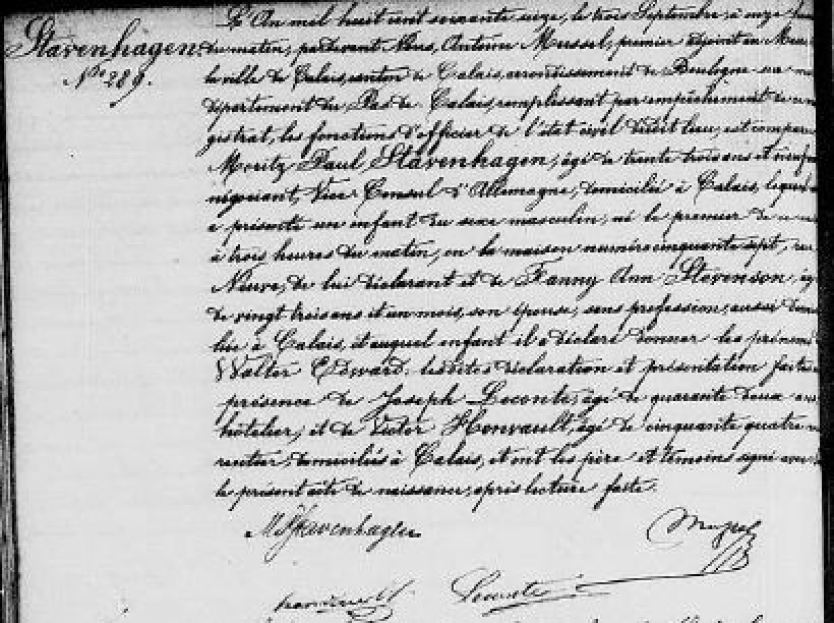
Achim sent me the birth certificates for Walter and his four siblings; all were born in Calais, France, thus are written in French which I read passably. I thought I might have difficulties deciphering the French handwriting, but in fact it is very legible. Walter’s birth certificate confirmed he was born on the 1st of September 1876. (Figure 14a) Below readers will find a French transcription and English translation of Walter’s birth certificate done for me by my second French cousin. (Figures 14b-c)
Walter Stavenhagen’s parents are named on his 1906 marriage certificate, Moritz Paul Stavenhagen and Fanny Ann Stevenson. (Figures 15a-b) Prior to connecting with Achim, I had already found Moritz and Fanny Ann’s marriage certificate showing they wed on the 19th of April 1873 in Saint Mary Abbots Church in Kensington, Middlesex, London, when he was supposedly 21 and she was 19. (Figure 16) I already knew Moritz had supposedly died on the 8th of January 1905 in Calais, France from the “England & Wales, National Probate Calendar (Index of Wills and Administration), 1858-1966, 1973-1995,” showing his will was administered on the 15th of June 1905 in London, leaving his effects to his wife. (Figure 17) As though to prove my point that family trees on ancestry are often unreliable, I found two trees with different years of birth for Moritz, 1842 and 1852, a discrepancy I was eventually able to sort out with primary source documents given to me by Achim.
Moritz Paul Stavenhagen (1842-1905) was actively involved in trading lace with a financier originally from Nottingham, England by the name of William Henry Stevenson (1807-1886). Moritz wound up marrying William’s adopted daughter, Fanny Ann Roche, whose mother Margarite Roche née Smith had married William in around 1872. William moved permanently to Calais, France after 1828 and became a naturalized citizen in 1831. (Figure 20)
Two 1907 French Phone Directory listings indicate that “Stevenson et Stavenhagen” were in business together in Calais (Figure 21), a collaboration they likely began in around 1872 (Figures 37a-b). Following William’s death in 1886, Moritz’s continued collaboration was with William’s stepson, Frederick, born in 1855 who could have been his natural son.
I initially theorized that Moritz might have apprenticed with William or his father, John Stevenson, in Nottingham, England, but Frank Webster-Smith, the reader who provided corrections and additions for this post, pointed out that John was dead before Moritz was born and William was already living in Calais. According to the information in Figures 37a-b, in 1870 Moritz still lived in Nottingham, though he eventually moved to Calais from there. Frank theorizes rather that Moritz may well have acted as an agent for William in Nottingham in the early 1870s and picked up knowledge of lace business there.
Interestingly, John Stevenson together with his partner Richard Skipworth appear to have provided financing to a John Leaver, a reclusive genius from Nottinghamshire, recognized today as the “father” of modern lace making, who developed the prototype for machine-made lace. Suffice it to say, the history of lace making is fascinating, and partially explains the connection between England and France in this endeavor in the early-to-mid 1800’s.
According to the directories, it seems the trading company was in Calais proper, while the “succursale,” branch office or fabrication site, was in Caudry, 105 miles to the southeast of Calais. (Figure 22)
Achim sent me two death notices for Moritz Paul Stavenhagen from “Le Petit Calaisian” published after his death on the 8th of January 1905. He was identified as “négociant en matières premières, commissionnaire en tulles, vice consul d’allemagne à Calais,” commodities trader, tulles commission agent, and German vice consul in Calais. (Tulles is a sheer often stiffened silk, rayon, or nylon net used chiefly for veils or ballet costumes that was exported from England.) The death notice remarked that Moritz had been the German vice consul in Calais for 35 years. (Figure 23)
Achim also sent me Moritz’s Calais death certificate (Figure 24), which served to further muddy the waters because the vital data for Moritz, his wife, and his son Paul differs from dates in other primary source documents, specifically, birth and marriage records. Moritz’s death certificate says he died on the 9th of January, rather than the 8th of January 1905 cited elsewhere, at the age of 62 years and 3 months; this would mean he was born in 1842 contradicting what is written on his 1873 marriage certificate saying he was 21 at the time, meaning he would have been born in 1852. Moritz’s wife Fanny Ann Stevenson is said to be 49 years old at the time of his death when she was known to have been born in 1853 and would have been 51; similarly, Moritz’s son, Paul Stavenhagen, is said to have been 27 years in 1905 when he was in fact 29. What to make of all these discrepancies is unclear. I mention this because I often harp about tying vital events to primary source documents, but this is proof there can be discrepancies among even well-sourced certificates.
Another fascinating document Achim shared with me was a letter dated the 23rd of May 1872 appointing Moritz Stavenhagen as German vice consul in Calais. (Figures 25a-b) This would seem to confirm that Moritz was born in 1842 since he would have been only 20 years old in 1872 had he been born in 1852, rather young in my opinion to be appointed vice consul. Another 1907 French Phone Directory lists “Stavenhagen” as the German vice consul. (Figure 26)
A brief digression to recount some of what Achim related. By any measure, the Stavenhagen family were cosmopolitan with ties to Germany, England, and France. At the start of WWI in 1914, the French determined the Stavenhagens to be Germans, and liquidated their businesses. The French newspapers of the day apparently took great delight in the fact German bombs destroyed Stavenhagen’s house during the WWI. Later, during the Nazi era, the family was judged to be Jewish with a predictable outcome. Members of the family who were Anglicans escaped to England, mixed marriages fell apart, and others were murdered in the Holocaust.
We know from Moritz and Fanny Ann’s 1873 marriage certificate they were married in the Anglican Church in Kensington. I naturally assumed that Moritz had converted from Judaism, but such was not the case, according to Achim. His death notice from the “Le Petit Calaisian” dated the 12th of January 1905 states that he was Jewish and that his funeral was presided over by a rabbi from Boulogne-sur-mer, France. (Figure 27) It seems odd Moritz was married in the Anglican Church as a Jew, but then again, neither Moritz nor Fanny’s religion is denoted on the certificate.
As previously mentioned, Moritz’s wife, Fanny Ann Stevenson, was the adopted daughter of William Henry Stevenson; she was born in 1853 in Campagne-Les-Guines, France. Remarkably, Achim was able to track down census records from Campagne-les-Guines, respectively, from 1856 (Figure 28a), 1861 (Figure 28b), and 1866 (Figures 28c-d) with Fanny Ann’s name on it. It’s not entirely clear when or if Fanny’s mother, Margarite (Margueritte in French) Roche née Smith, married William Henry Stevenson, but at some point Fanny and her brother or half-brother, Frederick, took the Stevenson surname. There is no question William deemed these children to be his own because in his 1886 will, they each inherited one-third of his estate, with the last third left to other heirs. (Figure 29)
In closing what I realize is an involved and overly lengthy post on Walter Stavenhagen and his family (Figures 30-36), I want to end on a touching note. While researching his wife’s ancestry in her final months, Achim related how he would give Silke daily updates on his newest genealogical finds, including the day he discovered the fate of Walter’s two sons, revelations that brought her great joy and calm towards the end of her life.
Regular readers know that I am a stickler for accuracy. In recent posts, I have begun to include a table of vital statistics of the people I write about and their closest relatives, citing the source of the vital data. I expect this to be of zero interest to most readers, and I do this primarily for my own benefit so I can recollect where names, dates, places, etc. originate from. That said, I would emphasize to readers that compiling and documenting the source of vital data is a laborious task as the following table illustrates.
VITAL STATISTICS FOR WALTER EDWARD STAVENHAGEN & HIS IMMEDIATE FAMILY
NAME
EVENT
DATE
PLACE
SOURCE
Walter Edward Stavenhagen (self)
Birth
1 September 1876
Calais, France
Birth Certificate
Marriage (to Charlotte Bruck)
3 May 1906
Berlin, Germany
Marriage Certificate
Divorce (from Charlotte Bruck)
19 May 1910
Berlin, Germany
Notation on Marriage Certificate
Death
9 February 1937
Heilbronn, Germany
Death Certificate
Cremation
11 February 1937
Emilie Fanny Stavenhagen’s diary
Burial
15 February 1937
Soldin, Germany [today: Myślibórz, Poland]
Emilie Fanny Stavenhagen’s diary
Charlotte Stavenhagen née Bruck (wife)
Birth
17 August 1886
Berlin, Germany
Marriage Certificate
Marriage (to Walter Edward Stavenhagen)
3 May 1906
Berlin, Germany
Marriage Certificate
Divorce (from Walter Edward Stavenhagen)
19 May 1910
Berlin, Germany
Notation on Marriage Certificate
Death
5 June 1974
Stamford, Connecticut
Connecticut Death Index
Moritz Paul Stavenhagen (father)
Birth
3 October 1842
Neubrandenburg, Germany
Paul Moses Stavenhagen Facts & Events (from Achim Bucher); Marriage Certificate; Death Certificate; Walter Edward Stavenhagen’s Birth Certificate
Marriage (to Fanny Ann Stevenson)
19 April 1873
Kensington, London, England
London and Surrey, England, Marriage Bonds and Allegations, 1597-1921
Death
9 January 1905
Calais, France
Death Certificate
Probate
15 June 1905
London, England
England & Wales, National Probate Calendar, 1858-1966, 1973-1995
Fanny Ann Stavenhagen née
Roche adopted Stevenson (mother)
Birth
10 June 1853
Campagne-Les-Guines, France
Birth Certificate; William Henry Stevenson’s 24 February 1884 Last Will
Marriage
19 April 1873
Kensington, London, England
London and Surrey, England, Marriage Bonds and Allegations, 1597-1921
Death (buried in Nottingham, England)
8 September 1939
Nottingham, England
England & Wales, National Probate Calendar, 1858-1966, 1973-1995
Margarethe Marianne Just née Stavenhagen (sister)
Birth
14 February 1874
Calais, France
Birth Certificate; 1939 England & Wales Register
Marriage (to Aron Albert Just)
23 August 1897
Calais, France
Marriage Certificate
Death (buried in Nottingham, England)
1 July 1945
Nottingham, England
UK, Burial and Cremation Index, 1576-2014
Paul Henry Stavenhagen (brother)
Birth
22 May 1875
Calais, France
Birth Certificate; German Minority Census, 1939
Marriage (to Alice Violet Willmott)
17 January 1906
Leytonstone, Essex, England
Essex, England, Church of England Marriages, 1754-1935
Death
30 December 1946
Hamburg, Germany
England, Andrews Newspaper Index Cards, 1790-1976
Probate
27 August 1952
London, England
England & Wales, National Probate Calendar, 1858-1995
Note: In this post, I discuss the sad fate of Charlotte Bruck, my great-grandfather Fedor Bruck’s niece, a victim in this case not of the Holocaust but of a psychiatric disorder.
My great-grandfather, Fedor Bruck (1834-1892), was one of at least nine offspring of Samuel Bruck (1808-1863) (Figure 1) and Charlotte Bruck née Marle (1809-1861). (Figure 2) For context, Samuel Bruck and Fedor Bruck (Figure 3) were, respectively the first- and second-generation owners of the Bruck family hotel in Ratibor, Germany [today: Racibórz, Poland], the Bruck’s “Prinz von Preußen” Hotel. (Figure 4) The youngest of Samuel and Charlotte Bruck’s children and Fedor Bruck’s youngest sibling was Wilhelm Bruck (1849-1907). (Figure 5)
Wilhelm married a baroness named Margarete “Grete” Mathilde von Koschembahr (Figure 6), and because of the prestige the von Koschembahr name endowed, he adopted her surname, initially in hyphenated manner as Bruck-von Koschembahr; eventually upon some family members arrival in America the Bruck surname was dropped. Wilhelm Bruck and Margarete von Koschembahr had five children, including Charlotte “Lotte” Bruck (Figure 7), niece of my great-grandfather Fedor Bruck and subject of this post.
As a brief aside, Charlotte’s older brother and the oldest of Wilhelm and Margarete’s children was Gerhard Bruck von Koschembahr (1885-1961) (Figure 8), who emigrated to America in October 1938 with his wife and ten of their thirteen children (Figure 9), one of whom is still living. While I am in contact with descendants of virtually all other branches of my family whom I have written about in my family history blog, I have not yet established contact with this wing of my extended family. If precedent is any indication, descendants of the von Koschembahrs may in time stumble upon my blog and contact me.
With upwards of 900 people in my family tree, which I use primarily to orient myself to the people whom I discuss in my Blog, I have never previously written about Wilhelm Bruck (von Koschembahr). Still, because Charlotte Bruck is in my tree, one genealogist stumbled upon her name and contacted me asking whether I know the fate of Charlotte’s first husband, Walter Edward Stavenhagen. The inquiry, it so happens, came from Charlotte’s granddaughter, Brenda Jay Dunn née Lorenzen (Figure 10), and I explained I have been unable to discover Walter’s fate. Not unexpectedly, Jay told me much more about Charlotte’s family than I could tell her and provided family photographs, which is always immensely satisfying.
Prior to being contacted by Jay Dunn through ancestry on June 24, 2018, I had already uncovered multiple documents related to Charlotte Bruck, although my understanding of her three marriages and life was rather disjointed. Rather than try and inaccurately reconstruct what I already knew at the time, let me briefly highlight major events in her life.
Charlotte (Lottchen, Lotte, Lottel) Bruck got married for the first time on the 3rd of May 1906 in Berlin to the Protestant landowner Walter Edward Stavenhagen (Figures 11a-b) who owned an estate in Eichwerder in the district of Soldin, Germany [today: Myślibórz, Poland]. Though both of Charlotte’s parents were of Jewish descent, on her wedding certificate, Charlotte is identified as Protestant, indicating she and/or her parents had converted. Following her marriage to Walter at age 19, they moved to Soldin, and Charlotte gave birth to two sons there: Frederick Wilhelm Stavenhagen (1907-1997) and Hans Joachim Stavenhagen (1909-1947). (Figures 12-13a-b)
Charlotte first became ill following the birth of her second son, possibly the result of postpartum depression or a bi-polar disorder. Charlotte’s mother, Margarethe von Koschembahr Bruck (Figure 14), came and removed her from Walter Stavenhagen’s estate in 1909, whereupon she was briefly hospitalized in Schierke, located in the Harz Mountains of northern Germany. In a diary entry dated the 19th of November 1909, Charlotte’s maternal grandmother, Amalie Mockrauer von Koschembahr (1834-1918) (Figures 15-16), describes her granddaughter’s circumstances at the time:
“Ich bin furchtbar traurig über das Fehlschlagen von Lottchens Friedensversuch. Nachdem sie in Eichwerder (nördlich Mysliborz) mit den besten Vorsätzen und mit festem Muthe eintraf, sich in ihr Schicksal und ihre Pflichten zu fügen, benahm sich Walter abermals unglaublich lieblos, rücksichtslos und roh, so, daß es nach kurzer Zeit für Lotte unmöglich war Stand zu halten. Soweit mir berichtet wurde, ist alles geschehen, um es dem Mann leicht zu machen in Frieden zu leben, allein es war vergeblich. Krank und gebrochen mußte meine arme Lottel ihre Heimath für immer verlassen, nur begleitet von ihrem kleinen Fritzchen, den armen kleinen Hans gab der Mann nicht heraus. Mein armes Gretchen holte ihr Kind, Marianne und Kurt, die von großer Liebe und Treue sind, begleiteten sie. Lotte flüchtete nach Schierke (Ort im Harz), wohin ihr Gretchen nachfolgen mußte, da Lotte sehr krank ist. Welcher Schmerz ist es doch schon wegen der kleinen mutterbedürftigen Kinder! Welche große Sünde hat der bösartige Mann auf sich geladen! Mein lieber allmächtiger Gott hilf uns in dieser Noth!
Das alles muß ich so still für mich mittragen, denn mit Tilla kann ich mich nicht aussprechen – sie hat eine andere Anschauung vom Unglück der Menschen – sie kann froh darüber sein, während ich zwar ergeben aus Gottes Hand alles nehme, aber tief traurig an meine unglücklichen Kinder denke. Seitdem Martha von Schmidt der Tod von uns genommen hat, habe ich Niemanden, mit dem ich ein tröstliches Wort austauschen kann. Ach, wieviel Schwaches giebt es auf der Welt – der Kampf hört hier nicht auf und so sehnt man sich nach der ewigen Reise. –Mit Tilchen kann ich mich darüber deshalb nicht verstehen, weil sie glaubt das Unglück, welches der Herr schickt, soll die Menschen bessern und seine Gnade und Liebe erkennen lassen.”
ENGLISH TRANSLATION
“I am terribly saddened by the failure of Lottchen’s attempt at peace. After she arrived in Eichwerder (today north of Myślibórz, Poland) with the best of intentions and with firm courage to submit to her fate and duties, Walter again behaved in an unbelievably unloving, inconsiderate, and crude manner, so that after a short time it was impossible for Lotte to stand firm. As far as I was told, everything was done to make it easy for the man to live in peace, but it was in vain. Sick and broken, my poor Lottel had to leave her home forever, accompanied only by her little Fritzchen (Note: Charlotte’s older son Frederick); poor little Hans was not released by the man. My poor Gretchen (Note: Charlotte’s mother, Margarethe von Koschembahr) fetched her child, and Marianne and Kurt (Note: Charlotte’s younger sister and brother-in-law, Marianne & Kurt Polborn), who are of great love and loyalty, accompanied her. Lotte fled to Schierke (a place in the Harz Mountains in northern Germany), where Gretchen had to follow her, since Lotte was very ill. What a pain it is already because of the little children in need of a mother! What a great sin the wicked man has brought upon himself! My dear Almighty God help us in this distress!
I have to bear all this so quietly for myself, because I cannot talk to Tilla (Note: Tilla, Tilchen, was Margarethe von Koschembahr’s sister, Mathilde von Koschembahr) – she has a different view of people’s misfortune – she can be happy about it, while I humbly take everything from God’s hand, but think deeply sad about my unhappy children. Since death took Martha von Schmidt (Note: a friend of Amalie von Koschembahr, Charlotte’s grandmother) from us, I have no one with whom I can exchange a comforting word. Oh, how much weakness there is in the world – the struggle does not end here and so one longs for the eternal journey. I can’t get along with Tilchen because she believes that the misfortune the Lord sends should make people better and recognize His grace and love.”
Walter and Charlotte’s marriage certificate has a notation in the upper right-hand corner confirming they were divorced in Berlin on the 19th of May 1910. (Figure 17) Atypical of the time, Charlotte was granted custody of both of her boys because spousal abuse was suspected, as the diary entry above suggests.
According to family history, following her hospitalization in the Harz Mountains, Charlotte lived with her mother in Dresden, Germany until she remarried Karl Eduard Michaelis in 1913, a marriage which lasted only two years. At around this time, Charlotte again showed signs of mental illness, so her family sent her to America in 1915, to a hospital located in Minnesota; her two sons accompanied her to America. Her stay there was relatively brief because she soon moved to New Haven, Connecticut, where she met her third husband, Ernest Gustav Lorenzen (1876-1951), through the German Society there, whom she married around 1916. Ernest Lorenzen was a law professor at Yale University; he would eventually adopt both of Charlotte’s sons by Walter Stavenhagen, and they would take the Lorenzen surname. The 1920 U.S. Federal Census indicates Ernest and Charlotte living with her two sons in New Haven, Connecticut, (Figures 18-19) although by 1930, only Ernest and Charlotte’s older son Frederick lived together. (Figure 20) By 1940, Frederick was married with two daughters and his younger brother was living with them. (Figure 21)
Jay Dunn shared a remarkable letter with me dated 1940 written by the Superintendent of the Fairfield State Hospital in Connecticut where Charlotte Lorenzen née Bruck was permanently institutionalized as of around April 1939 until her death in June 1974. To me, this letter is noteworthy for two reasons. One, it is incredibly detailed as to Charlotte’s mental condition and institutionalization over the years, information I would assume would be confidential. And two, the letter was written at the request of Charlotte’s younger son, Hans Joachim Lorenzen, known in America as John Jay Lorenzen; it seems that John’s future father-in-law, William Sweet, sought a medical opinion as to the possibility of Charlotte’s mental condition being hereditary prior to his daughter Brenda’s marriage to John.
According to the 1940 letter, following Charlotte’s treatment in Minnesota and her relocation to New Haven, she appears to have been well until around 1921, then suffered another relapse from which she again improved by 1922; after 1925, however, she was institutionalized through the remainder of her life. While originally diagnosed with Manic Depressive Psychosis by 1928 she had become delusional. Over time, Charlotte’s original diagnosis was altered to Dementia Praecox, Paranoid Type, whose prognosis was not as good. Today, Dementia Praecox would more generally be referred to as schizophrenia. The Superintendent from the Fairfield State Hospital concluded as follows in his response to John Jay Lorenzen:
“Summing it up then in another manner I might say that if you consider yourself a normal individual in good physical health with no emotional problems which cannot be readily solved, I would not hesitate to contemplate marriage and would not entertain any undue fears that my children might inherit the illness of my parent. Unless one can definitely assure oneself that his heredity is too heavily tainted, I think one would do himself an injustice if he did not make every reasonable effort to live the kind of normal life to which everyone of us is certainly entitled.”
Ernst Lorenzen divorced Charlotte sometime after she was permanently institutionalized, and eventually got remarried. Charlotte’s older son Frederick (Figure 22-23) became a successful lawyer in New York and paid for his mother’s care throughout her life. Jay Dunn’s father, John Jay Lorenzen (Figure 24), obtained an MBA from Harvard around 1933, worked for a time as a stock broker for Smith Barney, then started a cola company called Zimba Kola (Figures 25-26) with a college friend. He was drafted in 1943, became an officer in the Navy (Figure 27), and was sent to the Pacific where he fought valiantly alongside General MacArthur in the battles of Okinawa and Leyte Gulf. He survived the war, only to commit suicide in 1947, likely from depression caused by PTSD, post-traumatic stress disorder. Though Charlotte Bruck and her sons came to America well before Hitler rose to power, her fate and that of her younger son were indeed sad tales.
One final fascinating anecdote. Gerhard Bruck von Koschembahr, Charlotte’s oldest brother mentioned above, like his father, also married a baroness, Hilda Alexandra von Zeidlitz and Neukirch (1891-1954). (Figures 28-29) Hilda’s mother, Cornelia Carnochan Roosevelt, married on the 3rd of February 1889 to Baron Clement Zeidlitz, was a distant relative of President Theodore Roosevelt. (see Figure 9) It is likely that Gerhard Bruck von Koschembahr was able to “disguise” his Jewish ancestry by dropping the Bruck surname. Thus, because of Gerhard’s wife’s connection to the Roosevelts, they sponsored Gerhard’s entrance into America in 1938 with his family at a time when many Jewish families trying to reach America by ship were turned away. The most notorious ship turned away from landing in the United States in the lead up to WWII was the German liner St. Louis carrying 937 passengers, almost all Jewish; the ship was forced to return to Europe, and more than a quarter of the refuges died in the Holocaust.
Note: In this post, I present photos of Josef and Rosalie Pauly’s nine children, my great-great-uncle and aunt’s offspring, showing them as young children, adolescents, young adults, middle aged, and elderly. Naturally, there are gaps in the photo sequences for some of the children.
I have often thought to myself that upon one’s birth, one is metaphorically handed an hourglass measuring the sands of time slowly or rapidly draining out. Regular readers may recall that in Post 89, I discussed my great-great-great-grandparents, Wilhelm Wolf Marle and his wife Rosalie (“Reisel”) Marle née Grätzer, whose headstones survive in the former Jewish Cemetery in Pless, Germany [today: Pszczyna, Poland]. (Figures 1-2) Given my musings about the passage of time, I was mildly surprised to see that an hourglass is carved into Rosalie Marle’s headstone signifying how quickly time passes. (Figure 2) Clearly, I can take no credit for the originality of this metaphor.
Josef Pauly (Figure 3) and Rosalie Pauly née Mockrauer (Figures 4-5), my great-great-uncle and aunt, had nine children all born in Posen, Germany [today: Poznan, Poland] between 1871 and 1885. (Figure 6) In perusing my digital collection of photographs, I realized I have photos of all of them capturing how they looked through the years. Not unexpectedly, there are gaps in the photo sequences for some of the children, which my third cousin, Andi Pauly, more closely aligned to this branch of my family, was partially able to fill. I think it is unusual to have a “continuous” sequence of photos for one’s relatives who were born in the 19th century and died in the 20th century, and for this reason I thought I would array these photos for readers to see. I certainly find it to be true that I can recognize photos of some of my ancestors from specific periods in their lives but not necessarily from other intervals in their lives; interestingly, I occasionally even find this to be true of photos of myself.
Below, readers will find a table with the vital statistics of Josef and Rosalie Pauly’s nine children. This is followed by the sequence of photos I have for each of them showing how differently they looked at various stages of their lives. The second-born child, Paula Pincus née Pauly, died youngest at age 49, while the last born, Therese Sandler née Pauly, was the longest lived at age 84. Three of the daughters, Helene Guttentag née Pauly, Elisabeth Herrnstadt née Pauly, and Margarethe Neisser née Pauly, died during the Holocaust, two by their own hands.
VITAL STATISTICS FOR JOSEF & ROSALIE PAULY’S CHILDREN
Note: This post tiers off the previous one where I discussed a Hermann Berliner with links to Ratibor, Germany [today: Racibórz, Poland], like my identically named great-grandfather; Ratibor is where my father was born and where many of my Jewish Silesian ancestors hail from. In trying to initially determine whether I was dealing with the same person, I accessed the Mormon Church’s online Jewish microfilm records found at familysearch.org to work out the solution. This post, thus, allows me to provide readers with a brief guide on how to access these records, as well as point out that even among primary source documents, which for me are the “gold standard,” errors can be found.
Genealogists today have the advantage of being able to access online from the comfort of home many microfilm records from towns across the globe that once could only be ordered, paid for, and have mailed to a local Mormon Family History Library. These microfilms can be accessed for free by registering and creating a personal account at “familysearch.org.” (Figure 1)
I will walk readers through the simple steps for retrieving these digital records, using Ratibor, Germany [today: Racibórz, Poland] as an example, the town in Upper Silesia where my father and many of his relatives were born and/or lived. After readers have created their free ancestry account, they should go to the portal page for “familysearch.org.” On the pulldown menu under “Search,” readers should select “Catalog” (Figure 2) which will take them to a page entitled “FamilySearch Catalog.” (Figure 3) Under “Place,” readers should type the name of the town they are seeking records from. In my case, I typed in Ratibor, although if I type in the current Polish name of the town, “Racibórz,” the results on the next screen will be slightly different. My suggestion, at least when researching towns formerly in Germany, is to type the former German town name as well as the current Polish town name; a simple Google search will give you the name of towns over time.
The “Catalog Print List” enumerates the records available for the town you have selected. For Ratibor, I was interested in “Jewish Records,” which yields “Matrikel, 1814-1940,” birth, marriage, and death registers for Ratibor from between 1814 and 1940. (Figure 4) A few things should be noted. First, the “Matrikel” are simply registers maintained by the Jewish synagogues. Second, they do not give you access to the underlying birth, marriage, and death certificates, assuming these still exist. Third, the “Matrikel” are not a complete register of all Jewish births, marriage, and deaths between 1814 and 1940. Because of the “Kulturkampf,” discussed in Post 12, after the early 1870’s, most birth, marriages, and deaths were no longer registered by religious denominations in Germany but were recorded as civil events. Oddly, the names of Jews who died following the “Kulturkampf” and were interred in the former Jewish cemetery in Ratibor or elsewhere in Germany are registered both in the Jewish microfilm records as well as in the civil ledgers.
Selecting “Matrikel, 1814-1940” yields a list of available digital films, in the case of Ratibor, LDS microfilms 1184447, 1184448, and 1184449. (Figure 5) On the far right, readers should see a camera icon on which they should click to be taken to the digital film. If a microfilm reel icon or key shows up above the camera icon, the microfilm is not generally available online and can only be viewed at the Mormon Family History Library in Salt Lake City.
I first accessed the microfilms for Ratibor, Germany [today: Racibórz, Poland] almost 40 years ago on a visit to the Family History Library in Salt Lake City. Years later, I would order and pay for these films to be sent to a local Mormon Family History Library, so I could leisurely examine and take notes on them. I created a table summarizing what I had found on births, deaths, and marriages for members of my extended family. However, given that the registers were handwritten in German and often indecipherable, my log was incomplete. Only more recently have I made the effort to have a German relative or friend translate previously unreadable words or phrases. This is considerably easier since individual microfilm pages can now easily be downloaded from the Mormon Church’s website for closer study. (Figure 6) Thus, I am constantly refining and learning new things from these microfilm, as I will illustrate below.
My maternal great-grandfather Hermann Berliner (1840-1910) is known to me through a single picture I have of him. (Figure 7) He was married to Olga Berliner née Braun (1852-1920), and the two were interred together in the former Jewish Cemetery in Ratibor. Together they had three children, my grandmother Else Bruck née Berliner (1873-1957), her older sister Margareth Braun née Berliner (1872-1942), who was murdered in the Holocaust, and a younger brother Alfred Max Berliner (1875-1921), who died young in Ratibor.
The Hermann Berliner who was the subject of Post 92 had a son, Ernst Berliner, born in 1878, which initially confused me into thinking my great-grandfather sired another child with a different woman, Sara Riesenfeld, although I eventually concluded they were two different Hermann Berliners. My great-grandfather was a “brauereimeister,” a master brewer (Figure 8), and likely inherited the brewery business from his father-in-law, Markus Braun, while the “other” Hermann Berliner was a Bank Director.
The birth register for Ratibor records the occupation or profession of the father. Even though I consider these registers primary source documents, my “gold standard” so to speak, they are not error-free. Consider the birth register listing for my grandmother Else Berliner. Her father is misidentified as a “maurermeister,” a master mason (Figure 9), when I know him to have been a master brewer. My German friend offered a possible explanation for this error. Upon my grandmother’s birth, her father’s profession may have been conveyed verbally, and the recorder may have misunderstood or incorrectly recorded what was said.
I discussed in Post 92 the process I followed in determining I was dealing with two different Hermann Berliners. Throughout the remainder of this post, I will focus on my great-grandfather, and how I figured out who his parents were. While this information was always in hand, it was only recently that a German friend translated a few key words that enabled me to understand what I had in hand.
Ratibor LDS microfilm roll 1184448 contains the death register for my great-grandfather Hermann Berliner, his wife and son, and his parents. The column headers and titles from the death register are italicized in German and translated in the table below; included is the information for Hermann (Figure 10) and his wife, Olga Berliner (Figure 11); Hermann’s father, Abraham Berliner (Figure 12); Hermann’s mother, Philippine Berliner (Figure 13); and Hermann’s son, Alfred Berliner (Figure 14):
A few comments on the table above. Part of my difficulty in recognizing Hermann Berliner’s parents is that his forename was not recorded in the death register. Instead, he was identified as “Stadtrath Berliner,” City Councilor Berliner, clearly a prominent citizen of Ratibor. “Frau Bruck,” that is to say “Else Bruck,” was my grandmother. Finally, because the relationship of the witnesses to the deceased was identified in the last column, I was eventually able to work out all their names and, in the case of wives, figure out their maiden names.
From the death register, I know that Hermann and Olga Berliner, and their son Alfred Berliner all died and were interred in Ratibor. In the case of Hermann’s parents, however, I learned his father Abraham Berliner was buried in Neisse (Figure 12), Germany [today: Nysa, Poland] and his mother Philippine Berliner was interred in Leobschütz, Germany [today: Głubczyce, Poland]. (Figure 13) Consequently, I next turned my attention to the LDS microfilm rolls, respectively, for Neisse and Leobschütz to see if I could learn anything more about Hermann’s parents.
LDS microfilm 1184444 includes the Jewish deaths in Neisse, Germany for the period when Abraham Berliner died. Given that Abraham died in Ratibor, supposedly in 1868, I had no reason to think his death was also registered in Neisse, yet it was. The only Abraham Berliner listed in the Neisse index of deaths died on the 21st of June 1858 (Figure 15), NOT in 1868 as LDS Microfilm Roll 1184448 indicates. Given the precise death date in the Neisse register, I am inclined to believe 1858 is the correct year of Abraham’s death and this is in fact Hermann Berliner’s father. Readers may wonder why the Neisse death register is typed rather than handwritten. Occasionally, original registers are degraded so that for the data to be preserved, the original information must be transcribed.
In 2018, when I visited the archives in Ratibor for the third time, where the civil birth, marriage, and death records are stored from the time of the “Kulturkampf,” I found Hermann Berliner’s death certificate. (Figure 16) This not only confirmed his death date, but also showed where he was born in 1840, the town of Zülz, Germany [today: Biała Prudnicka, Poland]. So, along with Neisse and Leobschütz, this provided yet a third venue to search for microfilms. (Figure 17)
Hermann’s death certificate also gives his mother’s maiden name, Philippine Glogauer. As previously noted, she was buried in Leobschütz, Germany [today: Głubczyce, Poland]. Like her husband, Abraham Berliner, whose death was recorded in both Ratibor and Neisse, Philippine Berliner’s death was registered in both Ratibor and Leobschütz. Unlike vital records from Ratibor, some from Leobschütz have been digitized and are available on ancestry.com; I was able to find Philippine Berliner’s death certificate here. (Figure 17) Suffice it to say, her death certificate “pushes” Hermann Berliner’s lineage back yet another generation, naming his father-in-law as Isaac Glogauer. Philippine’s death certificate shows that like her husband and son she too was born in Zülz, Germany [today: Biała Prudnicka, Poland]. Family History Library Zülz Microfilm 1271493 registers births for all three of them, as well as the birth of one of Hermann Berliner’s younger siblings Julchen Berliner in 1842; Hermann Berliner had additional younger siblings, but they were born elsewhere in Silesia.
In closing, I would urge readers to focus not on the names of my family members whom I discuss but rather on the process of how I recovered data on their vital events, Readers may be able to follow a similar path to extract comparable information for their ancestors. As you do so, you too may discover that primary source documents are not without errors but that they may still be an improvement over vital data found in family trees developed by genealogists who copy and perpetuate inaccurate information.
VITAL STATISTICS FOR HERMANN BERLINER & HIS IMMEDIATE RELATIVES
NAME
(relationship)
VITAL EVENT
DATE
PLACE
SOURCE OF DATA
Hermann Berliner (self)
Birth
28 May 1840
Zülz, Germany [today: Biała Prudnicka, Poland]
Family History Library (FHL) Zülz Microfilm 1271493 (births)
(FIGURE 19)
Death
3 September 1910
Ratibor, Germany [today: Racibórz, Poland]
State Archives in Katowice Branch in Raciborz death certificate (FIGURE 16); FHL Ratibor Microfilms 1184447 (burials) (FIGURE 20) & 1184448 (deaths) (FIGURE 10); tombstone from former Jewish Cemetery in Ratibor
Olga Braun (wife)
Birth
23 July 1852
Ratibor, Germany [today: Racibórz, Poland]
FHL Ratibor Microfilm 1184449 (births)
Death
23 August 1920
Ratibor, Germany [today: Racibórz, Poland]
FHL Ratibor Microfilms 1184447 (burials) (FIGURE 20) & 1184448 (deaths) (FIGURE 11); tombstone from former Jewish Cemetery in Ratibor
Margareth Berliner (daughter)
Birth
19 March 1872
Ratibor, Germany [today: Racibórz, Poland]
FHL Ratibor Microfilm 1184449 (births)
Marriage (to Siegfried Brauer)
14 July 1891
Ratibor, Germany [today: Racibórz, Poland]
State Archives in Katowice Branch in Raciborz marriage certificate
Death
24 November 1942
Theresienstadt Ghetto, Czechoslovakia
Yad Vashem Victims’ Database
Else Berliner (daughter)
Birth
3 March 1873
Ratibor, Germany [today: Racibórz, Poland]
FHL Ratibor Microfilm 1184449 (births) (FIGURE 9)
Marriage (to Felix Bruck)
11 February 1894
Ratibor, Germany [today: Racibórz, Poland]
State Archives in Katowice Branch in Raciborz marriage certificate
Death
18 February 1957
Manhattan, New York
New York, Hebrew Burial Records (HFBA), Silver Lake and Mount Richmond Cemeteries, 1899-1991
Alfred Max Berliner (son)
Birth
6 November 1875
Ratibor, Germany [today: Racibórz, Poland]
State Archives in Katowice Branch in Raciborz marriage certificate; tombstone from former Jewish Cemetery in Ratibor
Marriage (to Charlotte Rothe)
17 January 1909
Meseritz, Germany [today:
Międzyrzecz, Poland]
Meseritz, Germany marriage certificate from ancestry.com
Death
19 February 1921
Ratibor, Germany [today: Racibórz, Poland]
FHL Ratibor Microfilm 1184448 (deaths); Ratibor death notice (FIGURE 21); tombstone from former Jewish Cemetery in Ratibor
Note: In this post, I discuss a man named Ernst Berliner born in 1878 in Ratibor, Germany to a Hermann Berliner, coincidentally the same name as my great-grandfather. Initially I thought Ernst might be a previously unknown great-uncle, a younger brother of my grandmother, Else Brucknée Berliner.
This story started simply when I queried ancestry.com for the surname “Berliner.” This was my grandmother Else Bruck’s maiden name, who was born on the 3rd of March 1873 in Ratibor, Germany [today: Racibórz, Poland]. I knew her as a child growing up in New York City, although she died when I was only six years old. (Figure 1) Not surprisingly, she never spoke to me about her siblings and ancestors. Had she done so, I would not in any case have remembered since none of my relatives ever reinforced this knowledge.
My search yielded an intriguing result, the name “Ernst Berliner.” This was an unexpected discovery because according to ancestry.com he was born on the 7th of March 1878 in Ratibor, where many of my father’s family were born. Given my familiarity with Berliners living there at around this time, I was uncertain whether or how he might be related to my grandmother. While Ernst Berliner’s birth certificate was not available online, from the records I could locate, it showed he had lived in Frankfurt am Main before WWII; had been a Bank Director there prior to the war; emigrated to England; had his German nationality annulled following his departure from Germany (Figure 2) and was registered in England as a World War II Alien Internee upon his arrival there (Figure 3); was registered as a “German Persecutee” in 1950 (Figure 4); died in Willesden, Middlesex, England on the 15th of February 1956; and according to the “Index of Wills and Administration” from the National Probate Calendar had his estate administered on the 29th of May 1956. (Figure 5) He left his personal effects to a married woman named Barbara Friedlaender, a domestic helper. The England Death Register only shows that Ernst died in the first quarter of 1956 but provides specific information in which English register his death certificate can be found. (Figure 6)
With this data in hand, I turned to the United Kingdom’s (UK) General Register Office online database and ordered Ernst Berliner’s death record in April 2020. Previous UK death certificates I have ordered sometimes name the father, and I was hoping this would again be the case. During these Covid-19 times, it took more than three months for the official document to arrive. But, when it arrived, I realized it included negligible new information and named neither his father nor any next-of-kin. (Figure 7) The person who caused Ernst Berliner’s body to be cremated, identified as Erica Weiss, I later learned was someone who probably worked in his household as a domestic helper.
Realizing there was little to be learned from the “backend” of Ernst’s life, I turned my attention to obtaining his birth certificate. Given Ernst’s year of birth in 1878, I knew the record would be among the civil records found at “Archiwum Państwowe w Katowicach Oddział w Raciborzu,” State Archives in Katowice Branch in Raciborz. I asked my historian friend from Racibórz, Poland, Mr. Paul Newerla, whether he could obtain a copy of Ernst Berliner’s birth certificate. Even though the State Archives is currently shuttered to the public on account of the Covid pandemic, Paul was able to contact their office and quickly obtain a copy of the document in question. (Figures 8a-b) The record identified Ernst’s father as Hermann Berliner, and, initially, I was stunned and excited by the discovery, thinking I had uncovered a previously unknown sibling of my grandmother. This would not have been unprecedented. In Post 34 and the postscripts, I discussed my grandmother’s older sister, Margareth “Grete” Brauer née Berliner, who I learned about from a single picture of her found among my cousin’s collection of family photographs (Figure 9); my great-aunt Grete Brauer was murdered in the Theresienstadt Ghetto on the 24th of November 1942 and was never mentioned to me growing up so I naturally assumed the same might have been true of a previously unknown great-uncle.
My grandmother was born in 1873, her older sister Grete in 1872, and her younger brother Alfred Max Berliner in 1875; the timing of Ernst’s birth in 1878 would not have been illogical. However, upon obtaining a translation of Ernst Berliner’s birth certificate, I discovered that his mother had not been my great-grandmother Olga Berliner née Braun but had instead been a Sara Riesenfeld.
I was next left to contemplate whether my great-grandfather Hermann Berliner (Figure 10) might have divorced his first wife and remarried this Sara. I swiftly concluded based on two pieces of evidence this was unlikely to have occurred. The Hermann Berliner who was married to Sara Riesenfeld was identified on their child’s birth certificate as a “hausierer,” an old-fashioned professional title meaning “street vendor,” or “door-to-door salesman.” I know that my great-grandfather was a “brauereimeister,” a master brewer, although I considered the possibility he might have changed professions after 1878. The more compelling evidence that I was looking at two different Hermann Berliners is that my great-grandparents Hermann and Olga were once interred together in the now destroyed Jewish Cemetery in Ratibor; I have a picture of their former headstone. (Figure 11)
Not entirely satisfied with the evidence I had mustered, I continued to look for further proof I was dealing with two different people by the same name. An 1889 Ratibor Address Book lists only one Hermann Berliner (Figure 12), so this was inconclusive.
I returned my attention to Ernst Berlin, and ultimately found in MyHeritage a “1939 Register of England and Wales,” with his name and the members of his household then residing in London. (Figure 13) His wife “Grete” (i.e., misidentified as “?Rete”) and her date of birth, 6th of June 1880 (i.e., she was actually born in July), were listed. I quickly discovered she was born in Breslau, Germany [today: Wrocław, Poland] as Grete Moskowicz. Like her husband and many other Jews, she had her German nationality annulled following her departure from Germany (Figure 14) and was registered in the United Kingdom as a World War II Alien Internee upon her arrival there. She died in London on the 7th of April 1940, and her probate hearing was held on the 25th of July 1940 (Figure 15); Ernst, shown to be a retired bank director, inherited. I have found no evidence that Ernst and Grete had any children.
I next turned my attention to family trees on ancestry.com and MyHeritage. With respect to these, I have often expressed my deep-seated concern that because these are not typically based on primary source documents, the data contained within them is often wrong. Compounding the problem is that genealogists developing their own trees often replicate errors from earlier trees. Still, I have begun to apply a principle I have learned from listening to an investment service to which I am subscribed that maintains the statistical data cited for stocks and companies may be “directionally correct but precisely wrong.” Applied to ancestral data, this means that while vital data of people included in trees may not always be precisely accurate, the relationship among the people may be correct.
Having had limited success finding additional information on Hermann Berliner, I turned my attention to his wife Sara Riesenfeld. Indirectly, I found a surprising amount of information on both in one family tree developed by a “Peter Lax,” confirming Ernst’s father was indeed a different Hermann Berliner than my great-grandfather (Figure 16); this tree identifies another of Hermann and Sara’s sons named Hans born on the 17th of February 1891 in Breslau. I also found the 1913 marriage certificate for a third son, Arthur Berliner, born on the 8th of September 1880, also in Breslau. (Figure 17a-b) According to Yad Vashem, both Arthur and Hans were murdered in the Shoah. There is quite a time span between the birth of Hermann and Sara Berliner’s three sons, 1878 to 1891, so the possibility of additional children exists. Still, based on the information in hand, it seems only Ernst survived the Holocaust.
Peter Lax’s tree, with more than 100,000 names in it, allows me to illustrate the point I was alluding to above that even the seemingly best documented trees contain errors. Case in point, Mr. Lax’s tree indicates Sara Riesenfeld was born on the 12th of January 1849 in Biała, Opolskie, Poland [formerly: Zülz, Germany], and identifies her father as “Israel Jacob Riesenfled (181601860).” (Figure 16) Consulting the Family History Library Microfilm Roll No. 1271493, found online at familysearch.org, with Jewish birth records from Zülz, Germany (Figure 18) for January of 1849, I could not initially locate Sara’s birth register listing. However, I eventually found her birth register listing under December of 1849. (Figure 19) Inadvertently, Peter Lax transposed “1/12/1849” (i.e., European designated date of 1st of December 1849) as “12/1/1849” (i.e., English designated date of the 12th of January 1849). This is another cautionary tale of consulting primary source documents where they exist to verify vital data.
One specific piece of information included in Peter Lax’s family tree was the purported place and date of birth of Ernst Berliner’s father, Hermann, on the 1st of June 1852 in Beuthen, Silesia [today: Bytom, Poland]. (Figure 20) I again turned to the Family History Library online microfilms to confirm this, and successfully found and had transcribed and translated Hermann Berliner’s birth register listing. (Figures 21a-b) Hermann’s birth register listing includes the names of his parents, Hirschel Berliner and Jalünder Rohel née Silbermann, both of whom I later found in the “Jewish Records Indexing-Poland” and “JewishGen Worldwide Burial Registry,” “JOWBR.” This allowed me to “push back” their ancestral tree another generation.
Having confirmed that Hermann Berliner, father of Ernst Berliner born on the 7th of March 1878 in Ratibor, was not my grandmother’s father prompted me to trace my great-grandfather’s lineage with reference to primary source documents. In the ensuing post, I will present this information. Regular readers know that without primary source documents in hand, I am most hesitant to accept ancestral and vital data found on other trees. Regarding my ancestral tree, I am much more interested in having well-sourced data and pictures on fewer people than unproven information going back multiple generations. While I assume there exists an ancestral connection between my grandmother Else Bruck née Berliner and Ernst Berliner and his ancestors, I have not yet ferreted out this relationship.
VITAL STATISTICS FOR ERNST BERLINER & HIS IMMEDIATE RELATIVES
NAME
(relationship)
VITAL EVENT
DATE
PLACE
SOURCE OF DATA
Ernst Berliner (self)
Birth
7 March 1878
Ratibor, Germany [today: Racibórz, Poland]
Ancestry.com;
State Archives in Katowice Branch in Raciborz birth certificate
Death
25 February 1956
Willesden, Middlesex, England
UK “Index of Wills and Administration, National Probate Calendar”;
UK General Register Office death certificate
Grete Moskowicz (wife)
Birth
6 July 1880
Breslau, Germany [today: Wrocław, Poland]
Multiple ancestry.com documents
Death
7 April 1940
Willesden, Middlesex, England
UK “Index of Wills and Administration, National Probate Calendar”
Hermann Berliner (father)
Birth
1 June 1852
Beuthen, Germany [today: Bytom, Poland]
Family History Library Microfilm Roll 1335074 (Beuthen, Germany)
Death
Kattowitz, Germany [today: Katowice, Poland]
Peter Lax Family Tree
Sara Riesenfeld (mother)
Birth
1 December 1849
Zülz, Germany [today: Biała, Poland]
Family History Library Microfilm Roll 1271493 (Zülz, Germany)
Note: This post is about the Kantorowicz branch of my family, many of whom originated in Posen, Prussia [today: Poznan, Poland], some of whom made their way to America or South America prior to WWII. It tiers off the previous post and delves into that part of the Kantorowicz family tree I reconstructed using photographs provided by Bettina Basanow née Meyer, discussed in Post 90, and her third cousin to whom she introduced me, Enid Sperber née Kent.
At the risk of immediately disengaging some readers by discussing a branch of my extended family that is of no interest to them, I encourage people to focus less on the specific individuals and more on the process by which I was able to reconstruct a part of the Kantorowicz family tree; these are steps fellow travelers may be able to replicate in researching their own families.
Let me provide some brief orientation. The Kantorowicz family, like the Pauly family I have often written about, both originated in Posen, Prussia [today: Poznan, Poland]. The patriarch of the Pauly family, Dr. Josef Pauly (1843-1916) (Figure 1) was married to Rosalie Mockrauer (1844-1927) (Figure 2), and together they had nine children, all of whom I have also written about. Josef Pauly’s sister was Rosalinde Pauly (1854-1916) (Figure 3), who was married to Max Kantorowicz (1843-1904). (Figure 4) I first came across Max and Rosalinde Kantorowicz in a group picture showing them attending the 1901 marriage of Josef and Rosalie Pauly’s daughter, Maria Pauly. (Figure 5) Using the Pauly Stammbaum, family tree, I was able to visualize connections between their families and my own, all of us related by marriage.
In Post 90, I told readers how my third cousin, Andi Pauly, gave a me copy of a letter his father Klaus had received in 1989 from Porto Alegre, Brazil from a Gertrud “Traute” Meyer née Milch (Figure 6), who was the granddaughter of Max Kantorowicz; attached to this letter were poor quality xerox photos of Max and his extended family. I also explained that through the auspices of my social media-savvy cousin, Danny Alejandro Sandler, I was eventually able to establish contact with Traute Meyer’s daughter, Bettina Basanow née Meyer (Figure 7), who has lived in Denver for the past 50 years.
Upon establishing contact with Bettina, I quickly asked her if she could send me higher quality examples of photos her mother had sent Klaus Pauly in 1989. Bettina graciously obliged and even included supplementary photos. One low resolution photo she sent shows five of Max Kantorowicz’s siblings, each identified by name. (Figure 8) While I made a mental note of the picture, I did not fully appreciate its significance at the time.
Fast forward. As I have mentioned on multiple occasions, I add people to my family tree primarily to orient myself to those I write about in my blog. As I was updating my tree and contemplating writing about the Kantorowicz branch, I checked both ancestry.com, and MyHeritage for Max’s siblings. Imagine my surprise when I came across a very high-resolution copy of the identical picture Bettina Basanow had sent of Max’s five siblings (Figure 9); unlike Bettina’s picture, however, the version on MyHeritage did not identify them by name. With a nice photo in hand and named relatives, I decided to add Max’s siblings to my tree. While I thought this would be the end of things, in fact it turned out to be merely the beginning.
I sent Bettina the better picture of Max Kantorowicz’s siblings, thinking she might be interested. At the same time, I also mentioned having once searched for descendants of Max Kantorowicz’s granddaughter, Vera Peters née Kantorowicz (1907-1994) (Figure 10), in California, to no avail. This prompted Bettina to suggest I contact a lifelong friend of hers, Enid Sperber née Kent, living in Los Angeles, who she thought might have had some contact with this branch of the family. Bettina explained that Enid was the daughter of William “Bill” Kent and Irene Tedrow, neither whose names resonated. In time, this would change, and I would make many more connections, and learn that Bettina and Enid are more than just friends, they are third cousins. But I am getting ahead of myself.
When Bettina suggested I contact Enid Sperber, she mentioned in passing that Enid had been an actress, her most famous role being as Nurse Bigelow in “M*A*S*H” (Figure 11) Her mother, Irene Tedrow, was also a well-known American character actress in stage, film, television, and radio. (Figure 12) Not being a “stargazer,” I merely made a mental note of this interesting fact while vaguely remembering there exists an ancestral program that allows interested genealogists to determine how many degrees of separation exist between them and people of fame. I am uncertain the specifics of how this program works, having never personally used it.
I was easily able to retrieve through a casual Google query a detailed history about the prominent Kantorowicz family from Posen and the liqueur factory established there in 1823 by a 17-year old Hartwig Kantorowicz. I downloaded and shared this history with Enid. Much has been written and can be found on the Kantorowicz family at this link, which it is not my intention to repeat here. What I was able to learn from the in-depth history, however, is that Hartwig Kantorowicz (1806-1871) who established the liqueur factory and his wife, Sophie Asch (1815-1863), supposedly had 13 children, 12 sons, only seven of whom survived. Based on what I have been able to learn, I think eight rather than seven survived into adulthood. More on this below.
Shortly after Enid and I began emailing, she sent pictures of paintings of Hartwig Kantorowicz’s parents, Joachim B. Kantorowicz (1783-1846) (Figure 13) and Rebecca Korach (1783-1873). (Figure 14) I considered myself exceptionally fortunate to obtain images of Jewish ancestors born in the late 18th Century. Given that their son Hartwig established a family business in Posen and was so prominent, surprisingly, I have so far been unable to find a photo of him. I even asked the Archiwum Państwowe w Poznaniu, The State Archives in Poznań, and they too have none.
Enid’s ancestral lineage was not entirely clear to me until she sent more pictures and provided more names. Like many other immigrants, the family’s name was Americanized upon their arrival here. Her father, born “Wilhelm Eduard Kantorowicz” (Figure 15) in Posen, changed his name to “William Edward Kent (1901-1974),” while her uncle, “Peter Curt Kantorowicz” (Figure 16), with his Hollywood good looks, was known as “Peter Curt Kent (1905-1969).” Enid also sent a picture of her grandfather, Hans Kantorowicz (1867-1934), with his two sons, Wilhelm and Peter. (Figure 17)
However, it was a picture Enid sent of her great-grandfather, Wilhelm Kantorowicz (1836-1894), with an unknown man named Siegfried (Figure 18), taken in 1860, that, in combination with a detailed family tree (Figure 19a) she provided, made it possible to ultimately work out her ancestry. It turns out, Siegfried and Wilhelm Kantorowicz were older brothers of the Max Kantorowicz previously discussed. I draw readers attention to the highlighted section of Figure 19a where their three names, along with the names of five other siblings shown in Figure 8 are all listed. (Figure 19b) From various sources, I now have pictures of all eight of Hartwig Kantorowicz and Sophie Asch’s children shown on the family tree.
The tree and pictures also allowed me to work out the ancestral connection between Enid and Bettina. Initially, Enid was under the impression that she and Bettina were not related to one another but had established a bond because both their families had escaped the Nazis. While, Bettina thought they were second cousins once removed. As the following schematic table shows, they are in fact third cousins.
Enid Sperber née Kent (b. 1945)
Bettina Bassanow née Meyer (b. 1940)
Father:
William Edward Kent (1901-1974)
(born Wilhelm Eduard Kantorowicz)
Mother:
Gertrud Meyer née Milch (1911-2010)
Grandfather:
Hans Kantorowicz (1867-1934)
Grandmother:
Else Milch née Kantorowicz (1875-1963)
Great-Grandfather:
Wilhelm Kantorowicz (1836-1894)
Great-Grandfather:
Max Kantorowicz (1843-1904)
Great-Great-Grandfather:
Hartwig Kantorowicz (1806-1871)
I am grateful for some intimate family photos Enid sent that she has given me permission to use, three of which I share with readers in this post. One is a heart-warming picture of Enid and her younger brother Roger Kent (1949-2018) as children standing with her parents in front of the paintings of Enid’s great-great-great-grandparents, Joachim B. Kantorowicz and Rebecca Korach. (Figure 20) And, the other two are throwbacks to a much simpler time that, as a former archaeologist, very much appeal to me. One shows Enid’s uncle Peter Curt Kent standing in front of his gas station, “‘Pete’ Kent,” in Cahuenga Pass (Figure 21a) and, the third, the gas station itself (Figure 21b), where the Hollywood Freeway now runs. In sharing this image, Enid noted that her Uncle Peter was never known to her or her brother as “Pete.”
Let me switch directions now. As previously mentioned, Hartwig Kantorowicz’s wife was Sophie Asch. In sharing her detailed family tree, Enid drew my attention to her great-great-grandmother’s links to a Sephardic Jew named Joseph Kalahora, purportedly born around 1495 in Kalahora, Spain. (Figure 22) A point of clarification. The narrow definition ethnically of a Sephardic Jew is a Jew descended from the Jews who lived in the Iberian Peninsula in the late 15th century, immediately prior to the issuance of the Alhambra Decree of 1492 by order of the Catholic Monarchs in Spain, and the decree of 1496 in Portugal by order of King Manuel I; as students of history know, these orders resulted in the expulsion of most Jews from the region in the late 15th Century.
Curious as to the possible linkage between Sephardic Jews and Eastern Europe, I did a Google query. I landed upon several articles discussing the origins of the Calahor(r)a (Kalahora) Family, including a post by Joel W. Davidi, an independent research historian and genealogist, writing in 2009 on his blog, “The Jewish History Channel (now known as Channeling Jewish History),” about this remarkable family in Poland. Below is a summary of what I learned.
The Calahora-Kalahora were a family of physicians, pharmacists, community leaders and Jewish scholars in Poland from the second half of the 16th Century until the 20th Century. The first known member of the family, Dr. Solomon Kalahora, was purportedly a pupil of the physician Brasavola in Ferrara, Italy, who settled in Kracow, Poland [also written as Kraków or Crakow] in the 16th century. Around 1570, he was appointed the court physician to the Polish King Sygmund August (1520-1572), an appointment that was continued by the subsequent King Stephen Bathory (1533-1586) in 1578. The Kalahora name would undergo many transformations, including Kolhari, Kolchor, Kolchory, Kalifari, Calaforra, Kalvari, Landsberg Posner, Zweigenbaul, Rabowsky, Olschwitz and Milsky. Though the Kalahoras came to Poland from Italy, the name reflects their Iberian roots, the Spanish town of Calahorra, where the family originated.
The patriarch Solomon Kalahora had six sons; one of them, Israel Solomon (1560-1640), the Rabbi of Lenchista, founded the Poznan branch of the family. One of Israel Samuel’s sons was Matityahu Calahora, who according to the contemporary Polish historian, Wespazjan Kochowski (1630-1700), was a “well-known physician with an extensive practice in Christian and even clerical circles.” Matityahu’s life came to a violent end when he became embroiled in a religious dispute with a Dominican friar named Havlin. The Russian-Jewish historian Simon Dubnow describes the event, gruesome in its details:
“The priest invited Calahora to a disputation in the cloister, but the Jew declined, promising to expound his views in writing. A few days later the priest found on his chair in the church a statement written in German and containing a violent arraignment of the cult of the Immaculate Virgin. It is not impossible that the statement was composed and placed in the church by an adherent of the ‘Reformation or the Arian heresy’ both of which were then the object of persecution in Poland. However, the Dominican decided that Calahora was the author, and brought the charge of blasphemy against him. The Court of the Royal Castle cross-examined the defendant under torture, without being able to obtain a confession. Witnesses testified that Calahora was not even able to write German. Being a native of Italy, he used the Italian language in his conversations with the Dominican. Despite all this evidence, the unfortunate Calahora was sentenced to be burned at the stake. The alarmed Jewish community raised a protest, and the case was accordingly transferred to the highest court in Piotrkov. The accused was sent in chains to Piotrkov, together with the plaintiff and the witnesses. But the arch-Catholic tribunal confirmed the verdict of the lower court, ordering that the sentence be executed in the following barbarous sequence: first the lips of the ” blasphemer ” to be cut off ; next his hand that had held the fateful statement to be burned; then the tongue, which had spoken against the Christian religion, to be excised; finally the body to be burned at the stake, and the ashes of the victim to be loaded into a cannon and discharged into the air. This cannibal ceremonial was faithfully carried out on December 13, 1663, on the marketplace of Piotrkov. For two centuries the Jews of Cracow followed the custom of reciting, on the fourteenth of Kislev, in the old synagogue of that city, a memorial prayer for the soul of the martyr Calahora.”
The grandson of Matiyahu’s brother Solomon was Aryeh Leib Kalifari (Figure 22); he was a preacher in Posen and the founder of the Landsberg and Posner families. After the son of a prominent citizen from a village near Posen was murdered around 1735, the Christian population there at once charged Jews with the crime, including Aryeh Leib. He became the second member of his family to be martyred when he was arrested and tortured by Catholic authorities during a blood libel. He died in prison after rebuffing an offer to spare his life if he converted.
While difficult to discern, the above names all appear in the family chart Enid Kent shared with me showing her great-great-great-grandmother’s ancestral links to the Sephardic Kalahora family. (Figure 22)
One final thing of note I came across. There exists a large mural painting by Julius Knorr (1810-1860) that is on permanent display today in Poznan’s Town Hall. Entitled “Marktplatz in Posen,” a section of this mural depicts a Rabbi Akiva Eger who is flanked on his left by Rabbi Yaakov Kalvari (originally Calahora), a member of his Rabbinic court and a descendant of the Calahora Sephardic family, The painting was done during the lifetime of Rabbi Akiva Eger and was first displayed in 1838. (Figure 23)
Davidi, Joel W. “Calahora, a remarkable Sephardic family in Poland.” The Jewish History Channel now known as Channeling Jewish History.15 January 2009. <https://ha-historion.blogspot.com/2009/01/>
Dubnow, Simon Markovich. History of the Jews in Russia and Poland. Pinnacle Press, 2017
Nawrocki, Stanisław. “History of Kantorowicz Family and their Factory.” Chronicle of the City of Poznan. No.4/ 1996
Note: In this brief post, I relate the story of tracking down with the help of a distant cousin the descendants of relatives who immigrated to Brazil in the leadup to WWII.
This story begins in 2016 when I first met my third cousin, Andreas “Andi” Pauly, in Munich. (Figure 1) By this time, I already had a hard copy of the Pauly family tree that his father, Klaus Pauly (Figure 2), had developed. Given the enormous amount of information recorded in this densely packed tree, it would be some time before I would work out and understand all the connections, and augment and make corrections to it.
Klaus Pauly developed the tree before email was widely available and before it was possible to create trees using online computer applications. For family members who had escaped the Holocaust and emigrated from Germany before WWII, Klaus was relegated to exchanging letters with faraway surviving relatives and waiting weeks for a reply. During our initial meeting in 2016, Andi Pauly brought along a letter his father had received in 1989 from a relative living in Porto Alegre, Brazil outlining her lineage and including poor quality xerox photos of her ancestors and descendants. It was only months later that I thought to ask Andi for a copy of the letter. I have my own tree on ancestry.com that I use primarily to visualize connections to people whom I write about in my Blog. When possible, I like to attach photos to people in my tree. Ergo, my request for a copy of the 1989 letter with the embedded photos.
With the correspondence, xerox photos, and family tree in hand, along with the copy of the envelope and mailing address showing where the letter had originated, I determined it had been sent by a woman named Gertrud “Traute” Meyer née Milch (1911-2010). (Figures 3-5) Using Klaus Pauly’s Stammbaum, family tree, I determined she was the granddaughter of Rosalinde Kantorowicz née Pauly, sister of Josef Pauly. Regular readers will recognize the Pauly family name as I have often written about them. Josef Pauly (1843-1916) (Figure 6), the patriarch and Andi’s great-grandfather, was married to Rosalie Pauly née Mockrauer (1844-1927) (Figure 7), and together they had nine children, eight of them daughters.
Because the Pauly and Meyer families had long ago lost contact, I was on my own trying to find Traute Meyer’s descendants. Initially, I sent a letter to the Meyer family at the Porto Alegre, Brazil address appearing on the 1989 letter hoping in vain the home might still be family-owned. After months of no reply, I turned to Facebook using my wife’s little-used account. I came across a few possible descendants but received no replies from any I tried to contact. Neither my wife or I are users of social media, so my efforts were half-hearted and eventually I desisted. My approach to doing forensic genealogy is to take the path of least resistance setting aside gnarly issues for another day in the hopes of ultimately obtaining more information. In earlier posts, I have mentioned to readers the difficulty in learning about Jewish families who relocated to South America since few records from there have been digitized.
Fast forward. In time, I would turn my attention to determining the fates and destinations of Josef and Rosalie Pauly’s nine children. The youngest of them, Therese “Tussy” Sandler née Pauly (1885-1969), was one of the last of their children whose destinies I was able to work out. (Figure 8) After traveling to Buenos Aires, Argentina in August 1937, then returning to Germany in November of that year, Tussy, her husband Ernst, and their two boys departed Germany for good in the nick of time in September 1938, settling in Buenos Aires. This is all I could learn from ancestry and MyHeritage, and Andi Pauly could add nothing to what might have happened to his great-aunt and her family following their arrival in South America.
When I launched my family history Blog in April 2017, I communicated a desire not only to relate tales of some of my Jewish ancestors who lived through interesting or noteworthy times, but also expressed the hope that relatives or descendants of the people I had written about might discover my Blog. In this latter regard, I have been rewarded on several occasions.
In April 2019, I had the good fortune of being contacted by Tussy Sandler’s grandson, Pedro Sandler (Figure 9), and great-grandson, Danny Alejandro Sandler (Figure 10), who had stumbled upon my Blog. Both now live in Florida, having immigrated there years ago. At first, my exchanges with Tussy’s descendants involved learning when and where their relatives lived and died and sharing what I have learned about their family and putting them in touch with Andi Pauly. The relationship quickly evolved into sharing family documents and photos (Figures 11-14) and enlisting my and Andi’s help with identifications. As an aside, of Josef and Rosalie Pauly’s nine children, only Therese Pauly’s descendants practice Judaism today.
Though Therese’s descendants originally hail from Argentina, one day I asked Pedro Sandler whether he knows anyone in the Jewish community in Brazil. Pedro had mentioned in passing that both his father and uncle had been very involved in Jewish life in Buenos Aires, so I was hoping he might know someone in the Jewish community in Brazil. My question was akin to encountering a visitor in a foreign land, telling them I come from San Diego, and having them ask me whether I know their friend from there. Clearly, there was no logic to my question. But as far-fetched as my query seems, Pedro in fact has a good friend living in Brazil whose wife’s parents knew Traute Meyer! The coincidence was remarkable.
Many months passed, then one day I asked Danny Sandler whether he or his father had ever managed to locate any of Traute Meyer’s offspring, and he told me that he had. I was surprised. Soon thereafter, Danny put me in touch with Bettina Basanow née Meyer (Figure 15), one of Traute Meyer’s four children. (Figure 16) While I had spent my time looking for her family in Brazil, Bettina has lived in the Denver area for more than 50 years, although her three siblings stayed in Brazil. (Figures 17-18) It should be noted that, unlike myself, Danny is active on social media so tracking down Bettina was relatively straight-forward.
I quickly got in touch with Bettina, and we have established a warm rapport. Regular readers know that finding distant relatives brings me pleasure not only for the stories they tell but also for old family photographs they send. Bettina shared some interesting family anecdotes and copies of some of the same pictures her mother had sent Klaus Pauly in 1989, completing a circle so to speak, but also sent new images as well. (Figures 19-20)
In the ensuing post, I will tell readers the story of Bettina’s third cousin to whom she introduced me and to whom I’m also distantly related. Bettina’s cousin also generously shared family photos and pictures of paintings of distant ancestors. This has led to expanding my family tree in most interesting ways, as readers will learn.
In closing I would say that while telling the tale of finding Traute Meyer’s descendants appears rather linear, I would never have located them without numerous intermediate steps and the help of a younger cousin better versed in social media.
Note: In this post, I discuss evidence of the Marle branch of my extended family from the late 18th Century-early 19th Century, which survives in the “Archiwum Panstwowe Oddzial Pszczyna,” State Archives Pszczyna [Poland] Branch, as well as in the Jewish cemetery that still exists there.
My father, Dr. Otto Bruck (1907-1994) (Figure 1), had an indifferent if not dismissive attitude towards his ancestors and next of kin apart from his beloved sister Susanne Müller née Bruck (1904-1942), murdered in Auschwitz. By contrast, my uncle Dr. Fedor Bruck (1895-1982) (Figure 1), the oldest of my father’s siblings, was deeply interested in his forefathers. Upon my uncle’s death in 1982, my aunt gave me a copy of an abbreviated family “tree” my uncle had developed. (Figure 2) This includes the earliest mention I can recollect of the Marle branch of my family, specifically, “Wilhelm MARLE” who was married to “Reisel G. (=GRAETZER).” My uncle’s schematic tree provided no vital dates for the Marles.
In time, I would learn from a German cousin that Wilhelm and Rosalie Marle’s headstones survive in the extant Jewish Cemetery in Pszczyna, Poland, formerly Pless, Prussia. During my and my wife’s 2014 visit to Ratibor [today: Racibórz, Poland], our English-speaking Polish friend, Malgosia Ploszaj, took us the to their graves, approximately 35 miles distant. (Figure 3) Malgosia, who hails from nearby Rybnik, Poland, formerly Rybnick, Prussia, is ardently interested in the history of Jews in Silesia and works with local volunteers to restore and raise fallen Jewish headstones throughout the area. In 2014, only Wilhelm Marle’s headstone had been restored and reset, but subsequently, his wife’s headstone has also been raised. I include pictures here of their beautifully rehabilitated tombstones.
[Just a quick footnote. I have variously found Wilhelm Marle’s wife’s forename spelled as “Reisel,” “Roesel,” “Rosel,” “Raizel,” and “Rosalie.” I will primarily use “Rosalie” as this name appears on her tombstone.]
Let me very briefly digress to provide some context. The subject of Post 88 was my third great-aunt, Antonie Pauly née Marle, an illegitimate daughter of the Rosalie Marle née Graetzer buried in Pszczyna; as previously discussed, Antonie was humorously if not sarcastically referred to as the “Queen of Tost,” even though she was born in Pszczyna not Toszek, Poland as Tost is today known.
Because Wilhelm and Rosalie Marle’s headstones are the very earliest known to me of any ancestors and relate to individuals born in the late 18th Century, I was particularly interested in learning more about them. Thus, I recently asked my friend, Ms. Madeleine Isenberg, affiliated as a volunteer with the Jewish Genealogical Society of Los Angeles, whether she could translate the Hebraic text on Wilhelm (Figures 4-6) and Rosalie Marle’s (Figures 7-9) headstones. Madeleine is fluent in Hebrew and is ardently interested in deciphering and interpreting Hebrew texts on headstones. Madeleine provided a beautiful translation and interpretation of the text on both tombstones.
A few points of clarification. “Kohen” is the Hebrew word for “priest,” thus, a member of the priestly class having certain rights and duties in the synagogue.
As to the reference that Wilhelm Marle’s father was a “chaver,” Madeleine explained that in today’s Hebrew, it would simply mean “friend,” but that at one time it was a sort of title. If a person studied at a yeshiva to gain the certification of a rabbi, it was with the intention he might serve a community as a rabbi or teacher. However, Madeleine found another “classification” of chaver in a paper entitled “Regulations of The Synagogue ‘Altneuschule’ In Prague In Their Historic Context” which I quote:
“In 18th Century Germany, there were two degrees of rabbinical ordination: the higher degree, using the title ‘moreinu’—our teacher or guide—given to scholars who devoted all their time to Torah study even after marriage and intended to serve the Rabbinate or as a Yeshiva teacher. The lower degree—chaver—was given to students before marriage who intended to take up a trade other than the Rabbinate.” (Gevaryahu & Sicherman 2010)
The German translation of “chaver” on Wilhelm Marle’s headstone is “Kaufmann,” merchant or businessman, indicating that he did not intend to become a rabbi or teacher.
As mentioned, the translation of Wilhelm and Rosalie Marle’s headstones was recently obtained. However, in December 2017, I was contacted through my family tree on ancestry.com by Professor Sławomir Pastuszka from Jagiellonian University in Kraków looking for information on the Marle family. While I was able to provide Professor Pastuszka with some new material, I was the primary beneficiary of our exchanges.
Professor Pastuszka’s data comes from the Archiwum Panstwowe Oddzial Pszczyna, State Archives Pszczyna Branch, located in Pszczyna proper, which is unavailable online. I will briefly summarize and provide some historic context for the information about Wilhelm and Rosalie Marle. Wilhelm Wolf Marle was born on the 14th of November 1772 in Pless to Isaac (Figure 10) and Magdalena (Figure 11), both of whom died before 1811 and are buried in the Mikołów Jewish Cemetery in Mikołów, Poland [formerly Nikolai, Prussia], a well-preserved Jewish cemetery; Mikołów is located about 19 miles or 30km north of Pszczyna. (Figure 12) The texts on most of the headstones in Mikołów are in Hebrew so without an interpreter it would be difficult for the average visitor to locate Wilhelm Marle’s parents’ headstones. (Figure 13)
The Marle families was one of the oldest Jewish families in Pless. According to censuses in the Pszczyna Archive, respectively from 1811 (Figure 14) and the 24th of March 1812 (Figure 15), Wilhelm Wolf Marle was also referred to as “Wolf Marle Schlesinger.” According to Sławomir, “Schlesinger” is a word in Schläsisch, or Silesian German, referring to “the Silesian.” Silesian German or Lower Silesian is a nearly extinct German dialect spoken in Silesia. It is part of the East Central German language area with some West Slavic and Lechitic influences. In German, Schläsisch is Schlesisch.
Wilhelm Marle married Rosalie Graetzer on the 15th of August 1799. Records show Rosalie was born in Tost, Prussia [today: Toszek, Poland] on the 19th of March 1780, daughter of Meyer and Goldine, both from Tost, Prussia. Her headstone states she was 70 years old when she died in October 1849, suggesting she may actually have been born in 1779 rather than 1780.
Other census records indicate Wilhelm Marle was variously a trader [1813], a shopkeeper [1814], and a merchant [1817,1820, 1821, 1822, 1823, 1839, 1842], and that in 1841, he owned a spice shop, an iron shop, and a money exchange.
On January 28, 1802, Wilhelm Marle took over a plot of land from his father with a tenement house located at Deutsche Vorstadt 4, worth 266 Thalers and 20 silver pennies. He sold the property on November 23, 1833. The house still stands today. (Figure 16) In 1814, Wilhelm bought a house at No. 18 on Market Square for 2500 Thalers from Heinrich Theiner, which his son Isaak Marle inherited upon his death. This house also still stands today. (Figure 17)
The cause of Wilhelm Marle’s death in 1846 was pulmonary edema.
Let me briefly digress to provide some historic context to enable readers to understand when and under what conditions Jews were provided with some civil equality in Prussia. On March 11, 1812, the Prussian King Frederick William III issued an edict that under the first article declared all legally resident Jews of Prussia to be citizens. Article 2 considered Jews to be natives [Einländer] and state citizens of Prussia provided they adopt strictly fixed surnames; that they use German or another living language not only in keeping their commercial records but also in the drawing of contracts and legal declarations of intention; and that they use only German or Latin script for their signatures. Articles 7 and 8 provided that all occupations were open to Jews including academic positions. Article 9, however, postponed the question of Jewish eligibility to state offices. In sum, the Edict provided some civil equality for Jews in exchange for their assumption of fixed surnames, their adoption of German “or another living language” in their professional activities and compliance with other civil duties, including military conscription.
Wilhelm and Rosalie’s dates of birth come from the census record of Pless Jews dated the 24th of March 1812, who, after the emancipation edict, became full citizens of Prussia. Professor Pastuszka emphasized these records contain many errors and dates are not always correct, but this is the only source where complete dates appear.
It was only after the issuance of the Edict of 1812 that Wilhelm Marle could run for office and be elected as one of the first two councilors of the Jewish confession in Pless.
Officially, as implied, Jews in the Kingdom of Prussia had to adopt surnames in 1812, before which they used “nicknames.” The last name “Marle” was originally a nickname used by Wilhelm’s father Isaac. In some documents Sławomir found Wilhelm listed as “Wolf Isaac,” meaning he was “Wolf son of Isaac.” Wilhelm’s mother “Magdalena,” did not have a maiden name. The only Pless census in which her name appears is the one from 1784 at which time she is shown to be 48 years old. (Figure 11)
After the Edict of 1812, women without maiden names typically adopted their father’s first name as a surname. For example, in Pless, a widow listed in the 1811 census named “Pessel Ephraim,” Pessel daughter of Ephraim, was known after her marriage in 1812 to “Abraham Grunthal” as “Pessel Grunthal née Ephraim.” On other occasions women used as their nicknames the nicknames of their fathers, as in the case of Rosalie Marle née Graetzer. Rosalie Graetzer’s mother, “Goldine,” does not appear to have had a surname. While not likely, if I can obtain a picture of her tombstone from the Mikołów Jewish Cemetery, I may be able to confirm this.
Let me move on to the subject of Wilhelm and Rosalie Marle’s children, and the evidence Professor Pastuszka was able to muster about them. Naturally, a few caveats are in order. As previously mentioned, Wilhelm and Rosalie married in 1799. The census of the 24th of March 1812 lists four of their children, namely, Goldine (b. 2nd April 1804), Moritz (b. 12th May 1806), Charlotte (b. 2nd October 1809, and Handel (b. 28th August 1812). (Figure 15) However, because no registers of births and deaths of Jews in Pless exist from before 1813, predating the Edict of 1812, we do not know how many additional children Wilhelm and Rosalie may have had between 1799 and 1812 who died at birth or in infancy.
In Pless censuses postdating the one of 1812, Professor Pastuszka found evidence of five additional children, specifically, Isaac Marle (b. 14th October 1814), Rosel Marle (b. 12th July 1817), Antonie Therese Marle (b. 1st February 1820), Fanny Marle (b. 14th March 1821) and Ernestine Marle (26th October 1822). A family tree archived in the Pinkus Family Collection at the Leo Baeck Institute (Figure 18), available online, coincides almost exactly with the names and number of Wilhelm and Rosalie’s children from the census data, with one exception, Handel Marle, born in 1812 who died a little more than a year later. Not surprisingly, there are notable differences in the years of birth of Wilhelm and Rosalie and their eight surviving children.
The compiled vital data for Wilhelm, his wife, and their nine known children is summarized in the table below, along with the source of the information. Whereas I consider the census records Professor Pastuszka retrieved from the Archiwum Panstwowe Oddzial Pszczyna to be primary source documents, I do not deem the vital data in the family tree from the Pinkus Family Collection to be such. Clearly, the more reliable vital data comes from the Pszczyna Archive.
VITAL STATISTICS FOR WILHELM WOLF MARLE, HIS WIFE & AND THEIR NINE KNOWN CHILDREN
NAME
(relationship)
VITAL EVENT
DATE
PLACE
SOURCE OF DATA
Wilhelm Wolf Marle (self)
[In Pless censuses from 1811 and 24th of March 1812, he was named Wolf Marle Schlesinger]
Birth
14 November 1772
Pless, Prussia [today: Pszczyna, Poland]
Pless Census of 24th of March 1812 (Pszczyna Archives)
Marriage to Rosalie Grätzer
15 August 1799
Tost, Germany [today: Toszek, Poland]
Death
31 October 1846
Pless, Prussia [today: Pszczyna, Poland]
Headstone in the Jewish cemetery in Pszczyna, Poland
Rosalie Graetzer (wife)
(Figure 19)
Birth
19 March 1780
Tost, Germany [today: Toszek, Poland]
Headstone in the Jewish cemetery in Pszczyna, Poland
Marriage to Wilhelm Marle
15 August 1799
Tost, Germany [today: Toszek, Poland]
Death
26 October 1849
Pless, Prussia [today: Pszczyna, Poland]
Headstone in the Jewish cemetery in Pszczyna, Poland
Goldine Marle (daughter)
Birth
2 April 1804
Pless, Prussia [today: Pszczyna, Poland]
Pless Census of 24th of March 1812 (Pszczyna Archives)
Marriage to Simon Pincus Oppler
10 December 1823
Rosenberg, Germany [today: Olesno, Poland]
Jewish Records Indexing-Poland (LDS Microfilm 1184449)
Death
1853
Kreuzburg, Germany [today: Kluczbork, Poland]
Pinkus Family Collection, Marle Family Tree
Moritz (Moses) Marle (son)
Birth
12 May 1806
Pless, Prussia [today: Pszczyna, Poland]
Pless Census of 24th of March 1812 (Pszczyna Archives)
Death
1866
Breslau, Germany [today: Wrocław, Poland]
Pinkus Family Collection, Marle Family Tree
Charlotte Marle (daughter)
(Figure 20)
Birth
2 October 1809
Pless, Prussia [today: Pszczyna, Poland]
Pless Census of 24th of March 1812 (Pszczyna Archives)
Marriage to Samuel Bruck
18 January 1831
Pless, Prussia [today: Pszczyna, Poland]
Death
17 August 1861
Ratibor, Germany [today: Racibórz, Poland]
Handel Marle (son)
Birth
28 August 1812
Pless, Prussia [today: Pszczyna, Poland]
Death
29 November 1813
Pless, Prussia [today: Pszczyna, Poland]
Isaak Marle (son)
Birth
15 October 1814
Pless, Prussia [today: Pszczyna, Poland]
Headstone in the former Jewish cemetery in Ratibor, Germany; Pinkus Family Collection, Marle Family Tree
Marriage to Friederike Traube
11 April 1842
Ratibor, Germany [today: Racibórz, Poland]
LDS Microfilm 1184449
Death
14 May 1884
Ratibor, Germany [today: Racibórz, Poland]
Headstone in the former Jewish cemetery in Ratibor, Germany; Pinkus Family Collection, Marle Family Tree
Rosalie Marle (illegitimate daughter of Rosalie Graetzer) (married to Jonas Bruck)
Birth
12 July 1817
Pless, Prussia [today: Pszczyna, Poland]
Headstone in the Old Jewish Cemetery in Wrocław
Death
6 June 1890
Breslau, Germany [today: Wrocław, Poland]
Headstone in the Old Jewish Cemetery in Wrocław
Antonie Marle (daughter) (married to Zadig Pauly) (Figures 21a-b)
Birth
1 February 1820
Pless, Prussia [today: Pszczyna, Poland]
Pinkus Family Collection, Marle Family Tree
Death
17 September 1893
Posen, Germany [today: Poznan, Poland]
Pinkus Family Collection, Marle Family Tree
Fanny Marle (daughter) (married to Salomon Mühsam)
Note: This short post is about Antonie Pauly née Marle, my third great-aunt or my great-great-great-aunt, regarding whom I made an interesting discovery. This finding touches on a quaint but satirical practice members of the upper class might once have employed to de-stigmatize public disapproval of an illegitimate child.
Regular readers will recall I have often written about my Pauly relatives. In Post 56, I wrote about the paterfamilias Josef Pauly (Figure 1), using his personal memoirs. With his wife Rosalie Pauly née Mockrauer (Figure 2), he bore nine children, eight of whom were daughters and all of whom have been the focus of earlier posts. The subject of this publication is Josef Pauly’s mother, Antonie Pauly née Marle (Figures 3-4), who was born in Pless, Germany [today: Pszczyna, Poland] and married to Zadig Pauly. (Figures 5-6) For most followers, I expect the discussion about my third great-aunt to be of limited interest, thus I encourage readers to focus not so much on who she was but on how and what we learn about the time in which she lived.
One of my younger cousins recently asked me about the notation below Antonie Marle’s name in the Pauly Stammbaum, family tree. (Figure 7) Being unable to decipher the writing and understand the German abbreviations, I turned to two friends who often assist me in interpreting and making sense of German documents and texts. Their translations were roughly identical, but one explication was amusing in its revelation. Let me explain.
The circled section of the Pauly family tree in Figure 7 reads as follows in German:
Antonie MARLE
1850-93, Posen
Unehel. Kd. v. Fürst Pless [=uneheliches Kind von Fürst Pless]
One correction I want to note before delving into the significance of the notation below Antonie Marle’s name in the Pauly family tree. Antonie’s year of birth is incorrectly noted on the Pauly Stammbaum as 1850, when in fact she was born in 1820. The correct information can be found on a Marle family tree in the Pinkus Family Collection archived at the Leo Baeck Institute showing Antonie’s parents and seven surviving siblings. (Figure 9) Further confirmation of Antonie’s date of birth comes from a Polish gentleman who contacted me through my family tree on ancestry and has accessed various census records from the 18th and 19th centuries from the archives in Pless registering births there. And, finally, the third source for Antonie’s year of birth can be found in the on-line Posen “Einwohnermeldezettel,” residential registration form, for Zadig Pauly and Antonie Marle. (Figure 10)
Both friends who transcribed and translated the notation on Antonie Marle agree that the sobriquet, “Queen of Tost,” was meant in jest, for amusement. Tost, known today as Toszek, Poland, is 50 miles or 80km north of Pszczyna, Poland.
One friend suggested Antonie’s father might have been Henry, Duke of Anhalt-Köthen (30 July 1778, Schloss Pless-23 November 1847, Köthen), who would have been only 42 years of age when Antonie was born, thus a theoretical possibility; Henry was a German prince in the House of Ascania, ruler of the non-sovereign principality of Anhalt-Pless.
My second friend suggested something I am more inclined to believe because of its mischievous implications. This gentleman is an experienced genealogist and in his years of doing ancestral research he has on multiple occasions come across family claims that a child was the illegitimate son or daughter of a Prince or noble; upon further investigations my friend found all these declarations to be fiction, complete fabrications. While there seems no reason to doubt that Antonie Marle might have been the result of an illicit affair, it is more plausible to believe it was the outcome of a tryst with a commoner or person of equal social standing. What I find so quaint is that her family could so easily thumb their nose at society’s mores by claiming Antonie was the illegitimate child of an affair with a monarch or sovereign, thus enveloping her in a mantle of respectability and superiority. No doubt, this fiction was an option only available to members of the upper classes.
Why Antonie Marle’s moniker was the “Queen of Tost” rather than the “Queen of Pless,” where she hailed from, is unclear, though possibly her biological father was from there. This is mere conjecture, and something we will likely never know.